Thursday, June 30, 2011
Praying Mantis Newborn
Wednesday, June 29, 2011
Shallots Dipped in Miso
Tuesday, June 28, 2011
Ichinomiya's Well Stocked Vegetable Vendors
Monday, June 27, 2011
New Takenoko Recipe
We just returned from a quick weekend trip to Chiba with a small group of friends. Just north of Tokyo, the prefecture is known for both farming and surfing, and we were able to taste a bit of both this weekend. (This is the same place where we met
the motorcycle-vegetable-delivering-grandmother
last year.)
Sunday, June 26, 2011
Sunday Reading, June 26th
Only a desire to not overwhelm folks with information kept me from making this list longer. What a great bundle of stuff popped up this week!
Friday, June 24, 2011
Tokyo's Farmers Markets: June 25th and 26th
It's hard to believe it's already the last weekend in
June
. Consolation for the rapid passage of time and therefore the quick succession of fantastic vegetables available? A great round of venues in which to visit, gather, and learn
how to cook those vegetables
!
Thursday, June 23, 2011
Saitama Tea Farm Post Up!
A summary of
our visit to a friend's chabatake (tea farm) in Saitama
is up and ready for reading over at
the Real Time Farms blog
. While the farm is not the sole source of their income, it is undoubtedly a treasured family place. Like so many others, the family voluntarily decided not to sell this year's crop, focusing instead on getting ready for next year's harvest.
Tuesday, June 21, 2011
Edamame Season Underway
Late last year the farmer's finished building three small greenhouses just south of what was then the chestnut orchard . Fairly simple affairs made of veneer and metal framing in comparison to their much larger and electronically-thermostated cousins right next door, these little houses proved cozy enough through the later winter months to be a good home for edamame.
Perhaps one of the quintessential Japanese foods, edamame are delightfully simple to prepare and wonderfully delicious. On the menu at every izakaya and served up almost without asking when in season, their salty selves are a perfect companion with beer. I revel in the additional fact that they are relatively healthy (off-setting the unhealthy bits of beer), and the shells make good compost fixings. Edamame (soy beans) are also the same bean (daizu) that miso and soy sauce are made from. Theoretically, I could use the beans I'm growing now in my garden (and mostly imagining with beer) to make either of those, tofu, or natto even. And while there are a number of different heirloom varieties in existence in Japan (Takashi Watanabe of Toziba , a fascinating farming non-profit focused on the heirloom soy bean , estimates Japan is home to hundreds of varieties tailored to their climates, regions, and grower's tastes), only a small number of those are still grown. According to Watanabe, less than 20-percent of the beans making Japan's tofu, soy sauce, and miso are grown in-country.
The edamame pictured here, though, while not an heirloom variety were grown here in Tokyo. The plan all along was to plant edamame ahead of schedule. The seeds went in the ground perhaps just after we returned from America , and were carefully shepherded along until a few days ago when we began harvesting in earnest. Big, fat, fuzzy beans dangle from the stems, and it's nigh on impossible on these hot days to not see them already sitting in a bowl before me accompanied by a lovely tall glass of beer. We pull up the entire plant, cut off the roots, and then bundle them into "bouquets" that are subsequently dunked in cool water before heading off to the store where they fetch a nice little sum. Or going in my bike basket to land in my kitchen where they get a good hot bath, a salty rub down, and then munched while still nearly too hot to handle.
Recipe
1 Bundle of edamame, removed from the stems
1 pan of boiling water
Salt
Bring the water to a good rolling boil and then dump in the edamame. (Don't splash. It will hurt.) Put the lid back on, and let the water return to a good boil for about 5 minutes or so. Drain. Pop in another bowl, sprinkle with salt as liberally as your doctor will allow. Serve hot or cold, and do your best to get your fair share and then some.
Sunday, June 19, 2011
Sunday Reading, June 19th
Friday, June 17, 2011
Tokyo Farmer's Markets: June 18th and 19th
The rainy season appears to be in full swing judging by the pool of water under the raincoat hanging in the hallway, but that should be no deterrent to exploring some of the best the city has to offer in terms of fruits, vegetables, and
farmer's markets
. What better way to celebrate Father's Day than with some of summer's finest such as edamame,
cucumbers
,
tomatoes
, or eggplants?
Sunday, June 12, 2011
Sunday Reading, June 12
Friday, June 10, 2011
Tokyo Farmer's Markets: June 11th and 12th
Thursday, June 9, 2011
Mulberries: Not Just for Silkworms
Spring is giving way to Summer these days, and so many of
the blossoms from May
are turning to
fruit
. One great example are the mulberry trees dotting our neighborhood and country by-ways. In Michigan we harvested them from a trees at relatives and friends homes, and I tossed them in
with whatever jam bubbled on the stove
. Here so far, I'm just nibbling them when out for a walk.
Wednesday, June 8, 2011
Tatami Mat Mulch
While
some weeds are my favorite garden volunteers
, there are times when I don't appreciate them. Last summer, for example, when we returned from
Hokkaido
I was greeted by a garden nearly hidden in tall weeds. Somehow despite the heat and drought they managed to thrive. Sheltered in part by

my rambling squash vines
, I'm sure, they resulted in more than a few hours in the hot sun removing them. And more than a little embarrassment, as the farmers keep an incredibly tidy farm and
my garden
is definitely...different.
Tuesday, June 7, 2011
First Harvest of the Season and a Secret Ingredient
Monday, June 6, 2011
Saitama Tea Farm Visit
We had the great good fortune to visit a friend's tea farm or
chabatake
this past weekend. Small growers just over the border from Tokyo in the mountains of
Saitama
-ken, they are concerned about traces of radiation found on this year's harvest. Standing in the fields just below the farmhouse in the sunshine, it's hard to believe there could be any problems other than the deer and monkey's that eat everything, apparently, except tea bushes. (Readers with deer problems should thank their lucky stars they don't also have to worry about clever monkeys with no compunction about using their
opposable
thumbs to dig up crops and gardens.)
Sunday, June 5, 2011
Sunday Reading
Saturday, June 4, 2011
Cucumber Trellis: The Scoop
Given the size of the farm - large by urban standards but small by country ones - the farmers
like others in the area
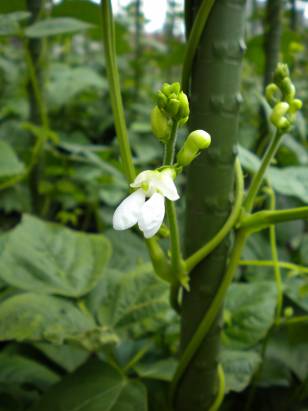
make good use of trellis' and poles for every crop. Growing vertically means more space, and can lead to healthier plants. Disease and critters that hang out at ground level struggle to make the journey upward where they meet wind, sun, and rain that can effectively weakens or destroy them. Trellising can also mean that as we weed, prune, and harvest that problems quickly become apparent. For example, stems broken by heavy winds this past weekend were spotted quickly and remedied. And just as easily we can discover the pleasures, i.e. the
bean's first orchid-like blossoms
and tiny, sliver-thin baby beans barely longer than my fingernail.
Over all of this we strung a net that essentially hangs to the bottom on both sides. We ran the base string out first, and then put the ends through the loops on the bottom of the net on either side. This saved us from trying to sew it through after the net was up. It also gave us a bottom 'rail' when it was finally time to spread the net out entirely. We then tied the base string to each end pole.
Friday, June 3, 2011
Tokyo's Farmers Markets: June
Thursday, June 2, 2011
Bean Blossoms
One of the summer crops most delightful and best kept secrets are their flowers. While it's easy for the mind to skip from seed to fruit, the first flower that gives a an early taste of pleasure to the gardener or farmer. Eggplant's lavender blossoms with their yellow pinpoint centers are almost pretty enough to raise on their own. Tucked under the signature purple tinted leaves and deep colored stems, it becomes a breathtaking plant that happens to produce a tasty and versatile vegetable. Similarly, a flowering potato offers up a handful of pretty little blossoms in white or purple, depending on the variety below, to signal the arrival of the first little tubers. Tomatoes, it must be said, offer a rather nondescript bloom; however, it could be argued that the beauty of its flower lies in the near magical formation over the course of days of a fruit multiple times its size.
This year, the surprise bloom for me belongs to the bean. My daily walk to the garden takes me past the greenhouses and cabbage fields nearly ready for harvest and the bean field. It affords ample opportunity to admire and notice the changes occurring daily. Ever rising, the vines are already taller than I am with wide lush green leaves. Most recently, the first flowers have appeared. Resembling nothing so much as miniature orchids they hang from the ends of stems tempting passing pollinators with the promise of a sweet beverage. In some cases tiny beans – fractionally longer perhaps than my fingernail – join them. While my heart delights, I confess my mouth also waters at the thought of a simple batch of these green lovelies whipped up in the style of Goma ai Shungiku or with lots of garlic and tomatoes like my good friend Maan makes.
Got a favorite vegetable flower? Let's hear it!
Wednesday, June 1, 2011
Kichijoji Farmer's Market