|
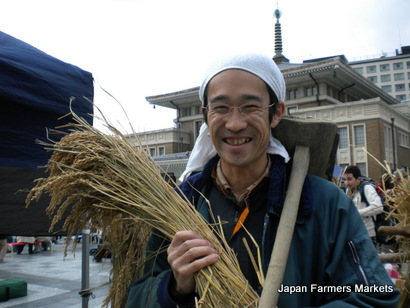
| Kazuto-san, whose lovely farm we'll be helping at. |
Monday, April 29, 2013
Off to a Natural Farm

Friday, April 26, 2013
Tokyo Farmers Markets: April 27th and 28th
|
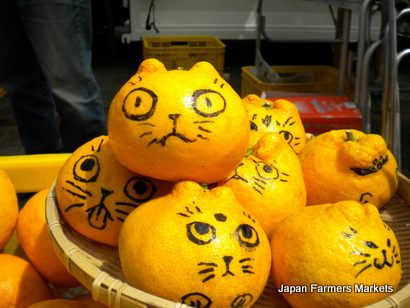
| Got citrus? Amanatsu at the Earth Day Market. So yummy, so cute. |
Every Saturday and Sunday
A massive weekend affair that is great fun and features a variety of fruits and vegetables and prepared products from all over Japan. Plus, there's a most excellent selection of food trucks offering everything from salad to zingy curry to roast chicken to falafel!
10am to 4pm
Every Saturday
A first
visit to this market
was well worth the trek for the number of organic growers and getting to meet a Tokyo farmer from just down the tracks in Kokobunji!
10am to 2pm
Yurakucho Farmer's Market
Every Saturday and Sunday
Smaller than the UNU Market, Yurakacho features a particular region of Japan each week along with an excellent selection of seasonal fruit and vegetables. Growers from nearby Chiba, Kamakura, and Saitama are also on hand to help fill the larder.
11am to 5pm
Directions: Turn left out of Yurakacho station and cross the courtyard toward Tokyo Kouku Keitan. Look for the fun under the overhang!
Every Saturday and Sunday
Smaller than the UNU Market, Yurakacho features a particular region of Japan each week along with an excellent selection of seasonal fruit and vegetables. Growers from nearby Chiba, Kamakura, and Saitama are also on hand to help fill the larder.
11am to 5pm
Directions: Turn left out of Yurakacho station and cross the courtyard toward Tokyo Kouku Keitan. Look for the fun under the overhang!
Know of a market?
Give me a shout
and we'll add it to the list!
Friday, April 19, 2013
Tokyo Farmers Markets: April 20th and 21st

|
|
Nakamura-san of Kougousei and his awesome homemade soil.
It goes well with the seeds he sells, too! April Earth Day Market |
Sunday, April 21st
11am to 5pm
A nice sized market held on the terrace just in front of Ebisu Garden Place that will always be special to me for introducing me to dried natto and
tea seedpods
.
Saturday, April 20th and Sunday, April 21st
10am to 5pm
Another great market in the city found with a little help from friends, this one is sure to not disappoint. My first visit was wonderful despite cold temperatures and a smattering of rain. Plus, Tohoku growers are on hand sharing their best-of-the-best, so come on out to be part of the recovery and get something good to eat.
No map, but just head out the east exit and look for the green awnings !
Koenji Farmer's Market
Saturday, April 20th
A new market I spotted while riding the train on a Saturday morning into the city center. That circle of red awnings in front of the Za-Koenji Public Theatre could only mean one thing! Sure enough, I found a small group of area growers and producers, and the bounty surely continues!
11am - 5pm
Map
Saturday, April 20th
A new market I spotted while riding the train on a Saturday morning into the city center. That circle of red awnings in front of the Za-Koenji Public Theatre could only mean one thing! Sure enough, I found a small group of area growers and producers, and the bounty surely continues!
11am - 5pm
Map
Saturday, April 20th
A unique event in the heart of the city that a
vegetable loving geek like me
wouldn't miss for the world. What better way to get the healthy vitamins and minerals you need to sustain an evening of karaoke and izakaya hopping?
5pm - 8pm
Every Saturday and Sunday
A massive weekend affair that is great fun and features a variety of fruits and vegetables and prepared products from all over Japan. Plus, there's a most excellent selection of food trucks offering everything from salad to zingy curry to roast chicken to falafel!
10am to 4pm
Every Saturday
A first
visit to this market
was well worth the trek for the number of organic growers and getting to meet a Tokyo farmer from just down the tracks in Kokobunji!
10am to 2pm
Yurakucho Farmer's Market
Every Saturday and Sunday
Smaller than the UNU Market, Yurakacho features a particular region of Japan each week along with an excellent selection of seasonal fruit and vegetables. Growers from nearby Chiba, Kamakura, and Saitama are also on hand to help fill the larder.
11am to 5pm
Directions: Turn left out of Yurakacho station and cross the courtyard toward Tokyo Kouku Keitan. Look for the fun under the overhang!
Every Saturday and Sunday
Smaller than the UNU Market, Yurakacho features a particular region of Japan each week along with an excellent selection of seasonal fruit and vegetables. Growers from nearby Chiba, Kamakura, and Saitama are also on hand to help fill the larder.
11am to 5pm
Directions: Turn left out of Yurakacho station and cross the courtyard toward Tokyo Kouku Keitan. Look for the fun under the overhang!
Know of a market?
Give me a shout
and we'll add it to the list!
Monday, April 15, 2013
Living Mulch for Containers
|
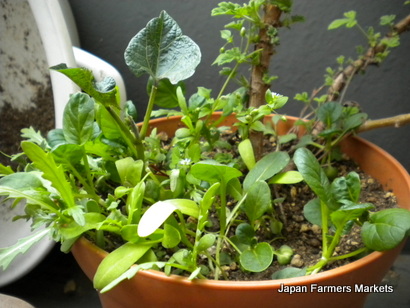
| The little riot of green, a.k.a. living mulch, in one of my pots on the balcony. |
At our farm the standard practice is to use a black plastic mulch that gets laid down by a heavy machine. It works well as a means to heat up the soil in cooler weather, keep down weeds, and retain moisture. But its plastic, requires fuel to be made and applied, and gets trashed at the end of the season. My farmers put it down for me each season after they till in whatever organic stuff I've spread on the soil. I see the appeal, but this year I'm opting out. The farm has grown and my farmers are crazy busy. The plastic and the fuel to make it and lay it out are expensive, and I don't want to cause them undue expense. They would never complain or deny it to me, but I still worry about it. And it's time to find an alternative.
These past years I've also done a fair bit of book reviewing for Permaculture Magazine and reading on my own about farming and gardening. The consistent message is that soil does best when left to its own devices. If I don't till, then the matrix that lives there only gets stronger and healthier. This in turn gives me healthier vegetables, herbs, and flowers, which makes them less susceptible to pests and disease. If I feed this matrix periodically with things like urine , leaves, straw, and my very own compost , it builds up, literally and figuratively, even more. (My garden beds where I've put some of these techniques into practice sit a full ten inches higher than the surrounding land.) If I grow a diversity of plants rather than a monoculture, this gives them an even further boost as pollinators and predators have a place to live and eat while pests and disease have less of an opportunity to settle in and wipe out a crop.
Ok, there's the philosophy. I dug out my old seeds and dumped them all in a jar, per LeVaux's advice. It's not fall, but who cares? They're seeds. I'm a farmer-type. There's open dirt in my garden. I set it next to my compost bucket headed to the farm the next day.
Then I set about repotting a few balcony plants. I'm scaling back pretty severely this year as we will be moving in March, but there are a few old friends and favorites I'm keeping around. As I filled the pots and gently patted down the fresh dirt, the seed jar caught my eye. "Open dirt," my farmer-self thought. Why not?
I opened the jar, sprinkled a handful of seeds over the surface of the soil in the pot, covered it over with a layer of dirt, and gave everybody a drink of water. Experiment underway.
Flash forward three weeks. The seeds have sprouted in a little riot of green that fills my heart with pleasure. Shungiku , scarlet runner beans , daizu , beets , and komatsuna are just a few of the things reaching for the sun at the moment. I'm not sure yet if it's the cosmos or the dill seeds that have sprouted, so I'll have to wait to report on that. Meanwhile, my mouth is watering.
How this will exactly play out once I start eating I don't know. Will I scatter more seeds? Will I just leave it be? How big will I let the seedlings get? Excellent questions all.
My advice so far, though, is to do it. Seriously, why not? For those that don't have a garden, this is a nice solution for old seeds and pots that dry out quickly. Mix in some legumes, i.e. peas, beans, daizu, sweet peas, etc., that will offer up some nitrogen to the soil and their companion plants. Herbs, greens, vegetables, and flowers are all fine. The worst that happens is you get a riot of green and color that could be mostly edible. (Don't eat the sweet peas, please.) Mulch away!
Friday, April 12, 2013
Tokyo Farmers Markets: April 13th and 14th
|
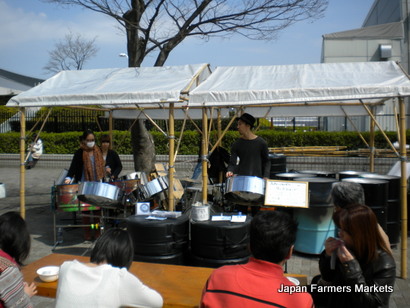
| You, too, can rock out at the Earth Day Market this weekend! |
Saturday, April 13th and Sunday, April 14th
A gem of a market hidden away in one of Tokyo's high-end shopping districts offering seasonal favorites in a way that feels homey yet rather boutique-y.
11am to 5pm
Map
Sunday, April 14th**
I could go wax on forever about how great this market is and how important it is for the future of Japanese farming. Instead, I'll just insist that folks go and see for themselves what great things the market and these innovative growers are doing.
10am to 4pm, Rain or shine!
**Note the slightly different timing this month!
**Note the slightly different timing this month!
Every Saturday and Sunday
A massive weekend affair that is great fun and features a variety of fruits and vegetables and prepared products from all over Japan. Plus, there's a most excellent selection of food trucks offering everything from salad to zingy curry to roast chicken to falafel!
10am to 4pm
Every Saturday
A first
visit to this market
was well worth the trek for the number of organic growers and getting to meet a Tokyo farmer from just down the tracks in Kokobunji!
10am to 2pm
Yurakucho Farmer's Market
Every Saturday and Sunday
Smaller than the UNU Market, Yurakacho features a particular region of Japan each week along with an excellent selection of seasonal fruit and vegetables. Growers from nearby Chiba, Kamakura, and Saitama are also on hand to help fill the larder.
11am to 5pm
Directions: Turn left out of Yurakacho station and cross the courtyard toward Tokyo Kouku Keitan. Look for the fun under the overhang!
Every Saturday and Sunday
Smaller than the UNU Market, Yurakacho features a particular region of Japan each week along with an excellent selection of seasonal fruit and vegetables. Growers from nearby Chiba, Kamakura, and Saitama are also on hand to help fill the larder.
11am to 5pm
Directions: Turn left out of Yurakacho station and cross the courtyard toward Tokyo Kouku Keitan. Look for the fun under the overhang!
Know of a market?
Give me a shout
and we'll add it to the list!
Monday, April 8, 2013
Egg Carton Greenhouse
|
|
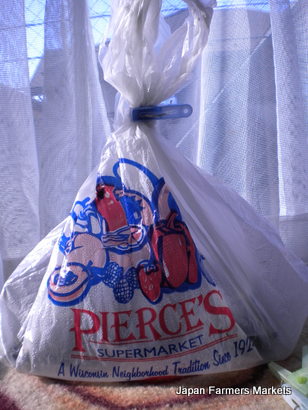
Egg carton garden in it's homemade greenhouse.
Please excuse the free advertising for my hometown grocery store. |
So, I made my own little greenhouse. Inspired by Cardboard Collective's numerous ingenious ideas and an aversion to plastic, I turned an egg carton into a planter and an old grocery bag into a greenhouse. So far so good, and it was easy to boot!
What you'll need:
- seeds
- cardboard egg carton
- seed starting soil (preferably. It tends to be light enough and often comes a bit pre-loaded with what seeds need to sprout.)
- a large-ish container
- shishkabob sticks, about eight
- a plastic grocery bag
- a small waterproof tray
- a clothespin
- a sunny window
Dampen the seed starting mix.
Plop some of the mix in a bowl or container and add some water. You're aiming for a damp texture, but not absolutely dripping. Dampening it first means you don't have to water once the seeds are planted, which can wash the seeds about and out of place. Especially if you're me and you don't have a watering can of any kind at home. Keep mixing until the soil sticks together in your hand.
|
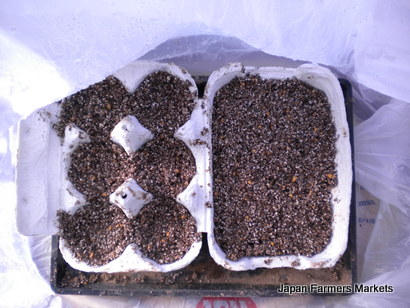
| Egg carton garden ready to grow! |
I filled both sides of the carton. The side where the eggs sit is nearly made for seed-starting, and the other side when laid open flat looks like a miniature garden. Leave a centimeter (give or take) of space between the top of the soil and the rim of the carton. You want this to be well-filled, but don't press it in too firmly. Seeds and roots need a bit of elbow room to grow and breathe, and a tightly packed soil doesn't give them any space for either of those things.
Plant your seeds.
I planted watermelon on the left side where the eggs sit as I had some leftover seeds from last year. (Sadly, these didn't sprout. A fresh egg carton is underway even as I type.) On the right I sprinkled morning glory seeds. I covered them with a thin layer of the seed starting mix and pressed it down firmly but gently over them. (The rough guide here to covering seeds is to bury them only about as deep as they are thick.) The seed needs good firm contact with the soil in order to sprout, but it can't be so tightly packed that the sprout can't push up to the light and the roots push down into the soil.
Set up the greenhouse.
- Place the egg carton on a tray (or other object) that fits squarely inside the bottom of the plastic grocery bag. The cardboard does get a bit soggy-saggy almost immediately, so having a tray of some kind or another keeps things under control.)
- Insert tray and carton inside the plastic bag. Check that it fits well enough that you can pull up the sides of the plastic bag easily and close it.
- Insert shishkabob sticks in the four outer corners and the four inner corners of the egg carton tray. Water will condense inside the bag as the interior heats up. This in turn will make the walls heavy. The sticks are just enough to help keep the plastic bag above the seedlings once they've sprouted. Not keeping them off the seedlings crushes them, but also makes a nice environment for molds and fungus that are not helpful in this situation.
- Lift the sides of the bag up and tie the handles together with a clothes pin. This helps the interior temperature of the greenhouse rise, which is what will encourage the seedlings to sprout. Periodic opening helps satisfy your curiosity, but can also keep a bit of air flowing, which helps prevent those molds and fungus' from growing, too. Be careful, though, as too much peeking will lower the temperature and result in slower sprouting or no sprouting.
- Set it in a sunny window and wait for your new friends to appear!
Friday, April 5, 2013
Tokyo Farmers Markets: April
|
|
Everybody loves a farmers market!
Taken at the March Earth Day Market. |
Sunday, April 7th
Sunday, April 21st
Sunday, April 21st
11am to 5pm
A nice sized market held on the terrace just in front of Ebisu Garden Place that will always be special to me for introducing me to dried natto and
tea seedpods
.
Saturday, April 13th and Sunday, April 14th
A gem of a market hidden away in one of Tokyo's high-end shopping districts offering seasonal favorites in a way that feels homey yet rather boutique-y.
11am to 5pm
Map
Sunday, April 14th**
I could go wax on forever about how great this market is and how important it is for the future of Japanese farming. Instead, I'll just insist that folks go and see for themselves what great things the market and these innovative growers are doing.
10am to 4pm, Rain or shine!
**Note the slightly different timing this month!
**Note the slightly different timing this month!
Saturday, April 20th and Sunday, April 21st
10am to 5pm
Another great market in the city found with a little help from friends, this one is sure to not disappoint. My first visit was wonderful despite cold temperatures and a smattering of rain. Plus, Tohoku growers are on hand sharing their best-of-the-best, so come on out to be part of the recovery and get something good to eat.
No map, but just head out the east exit and look for the green awnings !
Koenji Farmer's Market
Saturday, April 20th
A new market I spotted while riding the train on a Saturday morning into the city center. That circle of red awnings in front of the Za-Koenji Public Theatre could only mean one thing! Sure enough, I found a small group of area growers and producers, and the bounty surely continues!
11am - 5pm
Map
Saturday, April 20th
A new market I spotted while riding the train on a Saturday morning into the city center. That circle of red awnings in front of the Za-Koenji Public Theatre could only mean one thing! Sure enough, I found a small group of area growers and producers, and the bounty surely continues!
11am - 5pm
Map
Saturday, April 20th
A unique event in the heart of the city that a
vegetable loving geek like me
wouldn't miss for the world. What better way to get the healthy vitamins and minerals you need to sustain an evening of karaoke and izakaya hopping?
5pm - 8pm
Every Saturday and Sunday
A massive weekend affair that is great fun and features a variety of fruits and vegetables and prepared products from all over Japan. Plus, there's a most excellent selection of food trucks offering everything from salad to zingy curry to roast chicken to falafel!
10am to 4pm
Every Saturday
A first
visit to this market
was well worth the trek for the number of organic growers and getting to meet a Tokyo farmer from just down the tracks in Kokobunji!
10am to 2pm
Yurakucho Farmer's Market
Every Saturday and Sunday
Smaller than the UNU Market, Yurakacho features a particular region of Japan each week along with an excellent selection of seasonal fruit and vegetables. Growers from nearby Chiba, Kamakura, and Saitama are also on hand to help fill the larder.
11am to 5pm
Directions: Turn left out of Yurakacho station and cross the courtyard toward Tokyo Kouku Keitan. Look for the fun under the overhang!
Every Saturday and Sunday
Smaller than the UNU Market, Yurakacho features a particular region of Japan each week along with an excellent selection of seasonal fruit and vegetables. Growers from nearby Chiba, Kamakura, and Saitama are also on hand to help fill the larder.
11am to 5pm
Directions: Turn left out of Yurakacho station and cross the courtyard toward Tokyo Kouku Keitan. Look for the fun under the overhang!
Know of a market?
Give me a shout
and we'll add it to the list!
Monday, April 1, 2013
Making My Own Miso
|
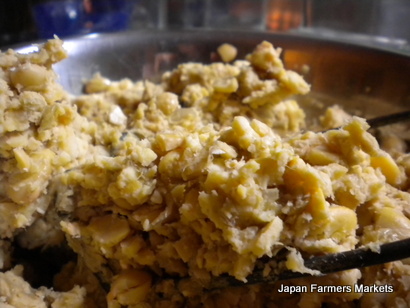
| Smashed beans, or how I made my own miso. |
Our first year here in Japan was full of food-making adventures:
umeboshi
,
sashimi
,
umeshu
, and
kimchi
. It was all good fun and led to a whole variety of other experiments. We now have what we call a Shu Closet, where we keep the many jars of fruit shus I've made over the years plus
an occasional brandy concoction
and
umehachimitsu
, a lovely non-alcoholic beverage perfect hot or cold.
Yet, the experiment that I've delayed out of a certain sense of intimidation is miso. A friend of the farmers stopped at the farm one day and offered a sample of some he'd made. It was chunky and yeasty smelling, and super delicious. It was amazing.

|
|
Daizu waiting to meet the koji and salt.
|
Flash forward four years, to a recent Earth Day Farmers Market I stopped at Yamamoto Farm's table as usual in search of their homemade mochi and miso. There to my pleasant surprise were bags of daizu and koji with salt. Without hesitation, I snapped them up and Yamamoto-san gave me detailed instructions on what to do. Giddy, I headed home with my loot and got to work.
|
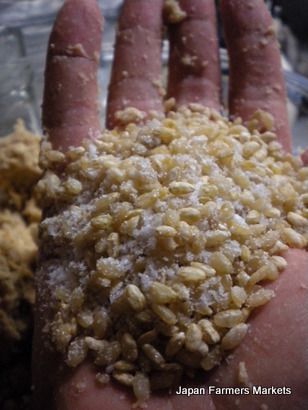
| Koji and salt simply waiting to meet the beans. |
1 kilogram soy beans.
1 kilogram of koji -infused rice and salt
- Soak the beans.
- Boil the beans.
- Drain and smash.
For smashing, I used an antique potato masher I'd purchased at an antique store in my hometown. Originally destined to help make jam, it worked like a charm on the beans. The texture proved rather chunky, though. I like it that way, but others may desire something smoother. A food processor or more time with the hand masher would do the trick.
- Add the koji and salt.
I'll never forget opening that bag of koji . The smell that emerged was yeasty and wonderful, putting me in mind of my bread-making days in America or peeking at my mother's coffeecake dough as it magically rose under a dishtowel in a corner of the kitchen. Pure joy and a connection with so many parts of the past and this new culture is what I felt right then. Even if my miso fails, this moment alone was totally worth it.
Koji is the yeast that gets busy fermenting and turning the daizu into miso or rice into sake. Word has it that it also makes a mean pickle. Its most common form is as koji -infused rice, which is how Yamamoto Farm sold it. I simply filled a cup or two, poured it over the smashed beans, and started mixing it, literally, by hand.
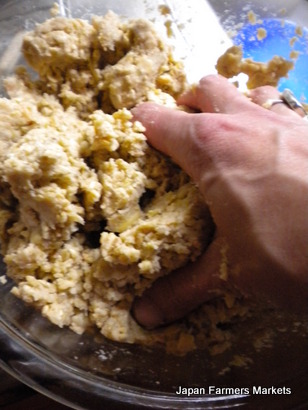
|
| Hand-mixing! |
As I worked the mixture in my hands I could feel the bits of beans that hadn't been completely smashed, and the grains of koji . It reminded me of kneading bread dough, a sort of meditative process that resulted in a warm feeling and a tasty treat to share with others.
- Salt the jar.
Katz recommends coating the bottom and sides of the miso container (a ceramic, glass or plastic bucket or jar) with salt to help the fermentation process. As it does with sauerkraut and umeboshi, the salt draws fluid out of the beans and creates a brine that flavors and preserves the miso.
- Place miso in jar and cover.
Once the jar was properly salted, I took great handfuls of the miso and placed it inside. I smashed it down tightly to remove any air bubbles and to make sure it would all fit. Once everything was in I put another layer of salt on the top and then added a weight. Yamamoto-san suggested a weight that was only ten-percent of the total amount. Katz doesn't suggest such a requirement. Both, however, do agree that the entire surface of the miso should be covered to ensure the best fermentation process.
- Wait.
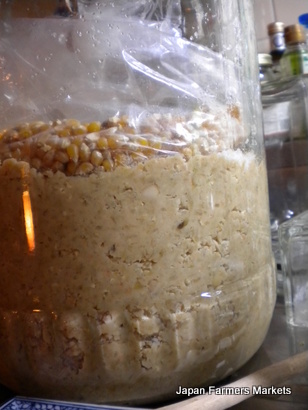
|
| My first miso, not perfect, but ready to ferment. |
Subscribe to:
Posts (Atom)