Showing posts with label fall gardening. Show all posts

Friday, December 3, 2010

Tokyo Garden Update: Late Fall

It's hard to believe December is already here. Not only are the winter crops all in at the farm, but harvest is going in earnest. Two crops of greens - shungiku and santosai - are already finished. The arugula is just about done, and we harvested the first of the wasabina this past Tuesday. The broccoli and cabbage are taking their own sweet time to fill out as needed, but I'm happy to wait. Komatsuna rolls in daily to fill our cart twice over and my salad bowl multiple times thereafter. Kabu and daikon are jumping on the bandwagon, too, so I've got no complaints. I should turn green with all the leaves I'm eating these days.
My own garden, is a slightly different story. Most of my own seeds and seedlings went in a bit late or sporadically. Our vacations and traveling with multiple rounds of guests meant that I devoted any free time at the farm to the farmers and their crops. My theory is that I don't attempt to make a living from my garden, so their fields are a higher priority.

The benefit of late planting though, is a later harvest. My arugula, shungiku, and first plantings of komatsuna are just coming into their own. (Later plantings are also coming up nicely, too.) All of my daikon are plumping up nicely, and daily removal of cabbage worms means my kole crops have minimal leaf damage. Both my green and purple karashina (I've mentioned my penchant for purple?) are doing beautifully, and their nutty leaves (flavor not character) make a pretty and delicious addition to our salads.
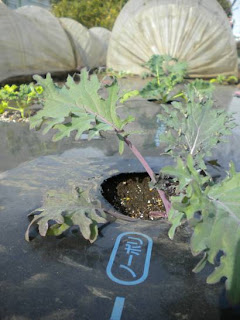


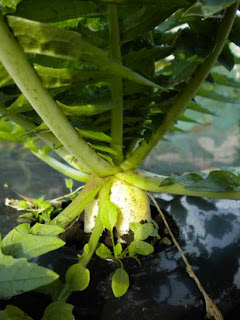
My kale plants - started late and set out late - appear to be happy for the most part. The Red Russian seems particularly pleased with my fall experiment with its big leaves and fairly robust growth given the short hours of daylight and the cold nights. The curly, though, does not seem as thrilled. Most of those plants remain small and even sport a yellow leaf or two. This may mean they would prefer to be set out earlier for a bit more growing time or perhaps covered against the cold. I'm not quite sure yet. (The photo here was actually taken a couple weeks ago. They're even bigger yet, I just realized, but this gives an idea of what's happening.)

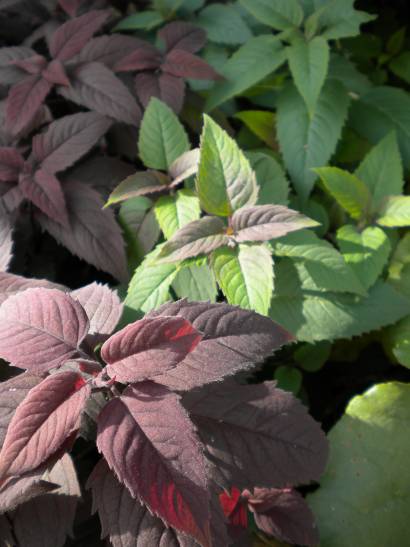
The yacon, as discussed, seems to be preparing for harvest, and the nira have gone to seed. The bergamont on the southern side of the rhubarb (all lined up in the westernmost bed) have turned a ruddy red color. The flavor is even stronger than regular bergamont, but I adore the shade they've chosen for the season. Interestingly, the bergamont on the north side of the rhubarb is still green. (I chose the photo up top as it shows all three shades: green, red, and heading red. As of today, it's all red.)

The rhubarb looks, like the yacon, happy as a lark. The leaves are lush and plenty. Giving in to a desire to make jam, I cut a few stems. The plant seems none the worse for wear, and so we'll see what happens. I've not made the jam yet, but I've got a new canner on my top shelf just crying out for a first go-round.

The lemon balm, mint, sage, and oregano all responded extremely well to a good pruning last month, and are full of new growth. Inspired by The Alternative Kitchen Garden, I planted some borage, too. I've known for a long time that it's blooms are beloved by many a pollinator, and reading Emma Cooper's entry about it was the last straw. It also seemed a good idea given the assorted challenges of this past summer. I'm hoping to create a welcome zone for pollinators and predators alike, and borage will undoubtedly help.

The lantanna, I noticed the other day, are also going great guns. Planted maybe only this spring, they are still blooming these days and have woody stems about as thick as my pointer finger. They look quite nice with the silvery-grey leaves of the neighboring lavender plant, and both are popular with passing pedestrians of the human and bug type.

Sunday, November 28, 2010

Front Balcony Garden in the Fall


Since moving to Tokyo nearly two years ago, I've had to relearn some things about growing in pots. It's been challenging to make the shift from garden beds to a series of pots of all sizes squished here and there on our balconies and windowsills, but I've enjoyed it. Many of the things I thought only of as summer herbs or vegetables in Michigan are here, in turn, happier in the cooler fall and winter days. (There's some experimental kale settled in the garden, and on the balconies I've added in some cilantro and parsley to see what will happen.)

My pots are now full of chrysanthemums blooming purple and gold, while a series of violas, a.k.a. Johnny-Jump-Ups turn their smiley little faces to the sun. Their yellow and blue and purple and gold blooms make a cheerful addition to our salads, as well, which is again a pleasant surprise. In Michigan, salad flowers are only a summer pleasure. Here, it seems, they may just be a fall and winter one.

Parsley and cilantro are both doing well, but the latter seems to really be enjoying itself. We've been adding its leaves as well to our salads, but also to soups and eggs. The flavor is strong and unique, and not always favored by everyone. Word has it that the Japanese in particular don't enjoy it, but so far I've heard no complaints nor seen any left on plates. Most people seem to even take seconds. Maybe I've just got the proportions right?

The pots this time around contain a mix of purchased compost and a scattering of composted chicken manure. I purchased both at a home improvement store not too far away. I managed to bring them home in my bike baskets, but it's no easy feat to ride with a 20 liter bag in the front and back. Each time I also had to fit in a plant or two I spotted on sale that I couldn't resist!

Monday, November 15, 2010

End of the Morning Glories

On my back balcony I've had a small yet lovely conflagration of morning glories. The leaves and flowers seemed to fill and absorb a whole section with green and purple. While they didn't create much shade for our kitchen (too far over to be effective) they did successfully shade the potted kale and made an otherwise nondescript space enticing for morning coffee.

So, with gratitude and a touch of sadness I'm preparing to take them down and compost them. I'll save some seeds back and maybe add them to our green curtain mix for next summer. Meanwhile, I'll also freshen the dirt in the pots and perhaps set out some cilantro, parsley, calendula, and violas for our winter salads.

Saturday, November 13, 2010

Nira Seed Collecting


Sunshine and pleasant temperatures enticed me out to the garden this morning. Our latest round of visitors left late this week, and so we're working on catching up on this and that. I'd made it to the farm to work a few times each week, but only to the garden to drop off compost.

The west bed, as I've mentioned before, is where I put perennial flowers and herbs, and where I'm experimenting a bit with building up the soil. I'd let some of my nira go to flower earlier in the season as the blooms were too pretty to not enjoy. In the back of my mind, too, was the idea that perhaps I might gather up some of the seeds for next year and for sharing.* That bright snap of garlic flavor makes it a popular ingredient in Asian dishes from Japan to China to Korea and even Thailand. It works wonders in soup, salad, and miso, and I want to make sure it's around come spring. (I've heard they make a great addition to kimchi, too!)

I snipped off the seed-heavy heads and popped them into a bag to transport them home. I haven't decided whether or not to hang them or set them on the ume baskets to finish drying. Either way, I should have a nice bundle of seeds for sharing in a few weeks!

*Word also has it that nira are invasive if the seed heads aren't snipped off in due time.

Monday, November 1, 2010

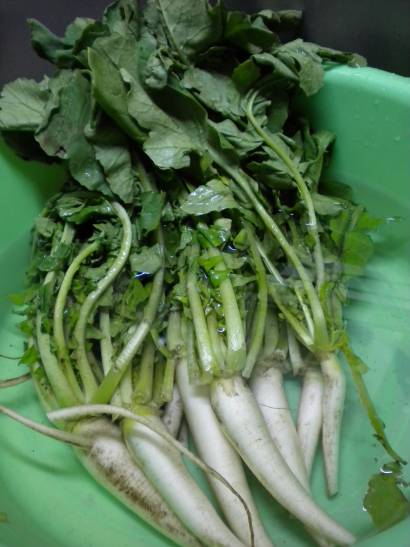
Thinned Daikon or Bathing Beauties

I picked these up at one of the nearby farms at their little vegetable stall. We've done our thinning (mabiki) of the daikons already at the farm, and we finished half of the kabu field on Friday. We ate the leaves in salad and sprinkled over our miso, and the roots got finely chopped in any assortment of salads, too.

The daikon is normally a mild-mannered member of the radish family, but these packed quite a pungent punch. (I am a fan of alliteration as well as farmer's markets.) If they maintain this kind of flavor as they get larger, they should be a spicy addition to our winter dishes!

Saturday, December 13, 2008

Rescuing the Swiss Chard

The Swiss Chard needed help. A little bit of frostbite turned parts of the stems brown and some of the leaves looked more than a little wilted. These now short plants still manage to push out some brilliant leaves that I gratefully harvest every so many days. But this situation could not last much longer.

We tackled the long talked of cold frame idea this past Saturday. We looked up a few different diagrams and plans, and settled on two possibilities. (There were tons more but these seemed the most helpful to us.) This cold frame description is helpful and describes what to watch out for and how a cold frame can be used. By far the simplest and most straight-forward explanation, this is the one we eventually decided to follow.

The Savvy Gardener offers a very nice description of cold frames and hot beds along with an assortment of building plans from the electric to the old window kind. I'd never heard the term hot bed before, but now I know that's what we were aiming for somewhat when we hauled in the horse manure. The site does a nice job explaining the wide variety of ways plants can be protected from the cold and how great a job each device does.

The cold frame is meant to go inside the hoophouse to add an additional layer of protection for the Swiss Chard. Eliot Coleman, author of The Four Season Harvest, inspired this idea. (His cold frames and hoophouses are near works of art, whereas ours are a bit more equivalent to cheap knock-offs of name brands. They may not last as long, but for now they get the job done.) By having a cold frame inside the hoophouse the growing season for things like swiss chard, parsley, and other semi-sensitive greens is extended in some cases right through the coldest weather.

We fashioned our cold frame from an old window a neighbor was throwing out, some old pipe insulation, and a cardboard box. We cut the cardboard to fit the window dimensions, angled the sides to drop and allow sunshine in, and used the insulation to offer a tighter seal between the window and the cardboard. We used cardboard because we were in a hurry, and we wanted a relatively safe test run before committing to wood. Plus, inside the hoophouse the cardboard won't break down very quickly at all.

We chose a spot where we could fit in the most Swiss Chard, and snuggled the frame into the dirt. I scooped in some of the horse manure to help seal the base further and offer a little additional warmth. The insulation went around the top, and the window went on top of that. Ta-dah! Cold frame in a hoophouse. Now we just need to rescue the Dinosaur kale, and the seedlings...

Monday, September 15, 2008

Fall in the Garden

The other day while perusing the garden to see what tomatoes might be ready I heard a soft buzzing. I looked up to see a hummingbird visiting my cosmos, zinnias, and maidenhair vine. A small "tweeting" sound came with each sip. It flew on in less than a minute, and my only wish was that I had more to offer the little one. As it got smaller and smaller in the distance, I thought about the migration it was most likely about to begin.

Frost is soon on its way, and this year it is particularly bittersweet for me as we plan our upcoming move to Japan. The opportunity to explore gardening and agriculture in another country is thrilling, not to mention all the cool vegetables and flowers I anticipate meeting during our time there. And I believe it will be good for these beds to rest from growing for a bit, although I am quite sure the grass running along the edge is already formulating a take-over strategy.

Yet, I feel a certain sadness as I look over the garden and listen to the bees. The garden is a source of food for us, but it is also a place of solace and joy for me. The time spent here with my hands in the dirt weeding and planting is meditative. Time slows down or stops as my hands carve a row for seeds or pull weeds to give the kale a bit more room. Sunlight warms my shoulders and the cats curl up in the shade of the leaves of the rhubarb plant. Bees buzz about the blooms of the bergamont and the sage blossoms, and I laugh at one that dives directly into the nasturtium blossom without hesitation.

I wonder how the damson trees will fare, and if we can arrange for a burn of our yard in the spring. Will the milkweed host more tussock moth caterpillars and will there be again more goldenrod and aster plants scattered throughout the yard? Should we arrange for someone to pick the pears and keep an eye on the apple trees? If I scatter the garlic seeds from my friend Karen how will I know they will take and who will weed around them? Should I arrange for someone to weed out the million tiny tansy plants I know will again try to take over the space?

Looking up from the garden to the blue sky above and the lines of the land that is not mine but is in some way because it forms part of my personal geography, I feel the beginnings of home. The wind in the tree line to our north also rustles the corn, and a praying mantis lumbers by. The chickens stroll the edge of the garden looking for a tomato hornworm, a tasty weed, or just a word of hello. As they work their final lap of the day and edge closer to their coop, the sky swings to orange and a gentle chill settles over us. My heart is settling here at last, finding its place.

Monday, August 18, 2008

Fall Planting

For the first time I've managed to plant a fall crop! I removed the pea vines and their trellises, and the onions practically leaped out of the ground in their fatness. I spread a good thick layer of compost and composted manure and then double dug it in for good measure.

I hope to find a fledgling crop of lacianto kale, calabrese, beets, and beans in a bit of time. These I hope to cover up for the winter along with the other half of the same bed that is currently home to curly kale, flat leaf parsely, and a ton of swiss chard. Harvesting our own winter greens will perhaps be a reality this year!