Showing posts with label America. Show all posts

Thursday, August 31, 2017

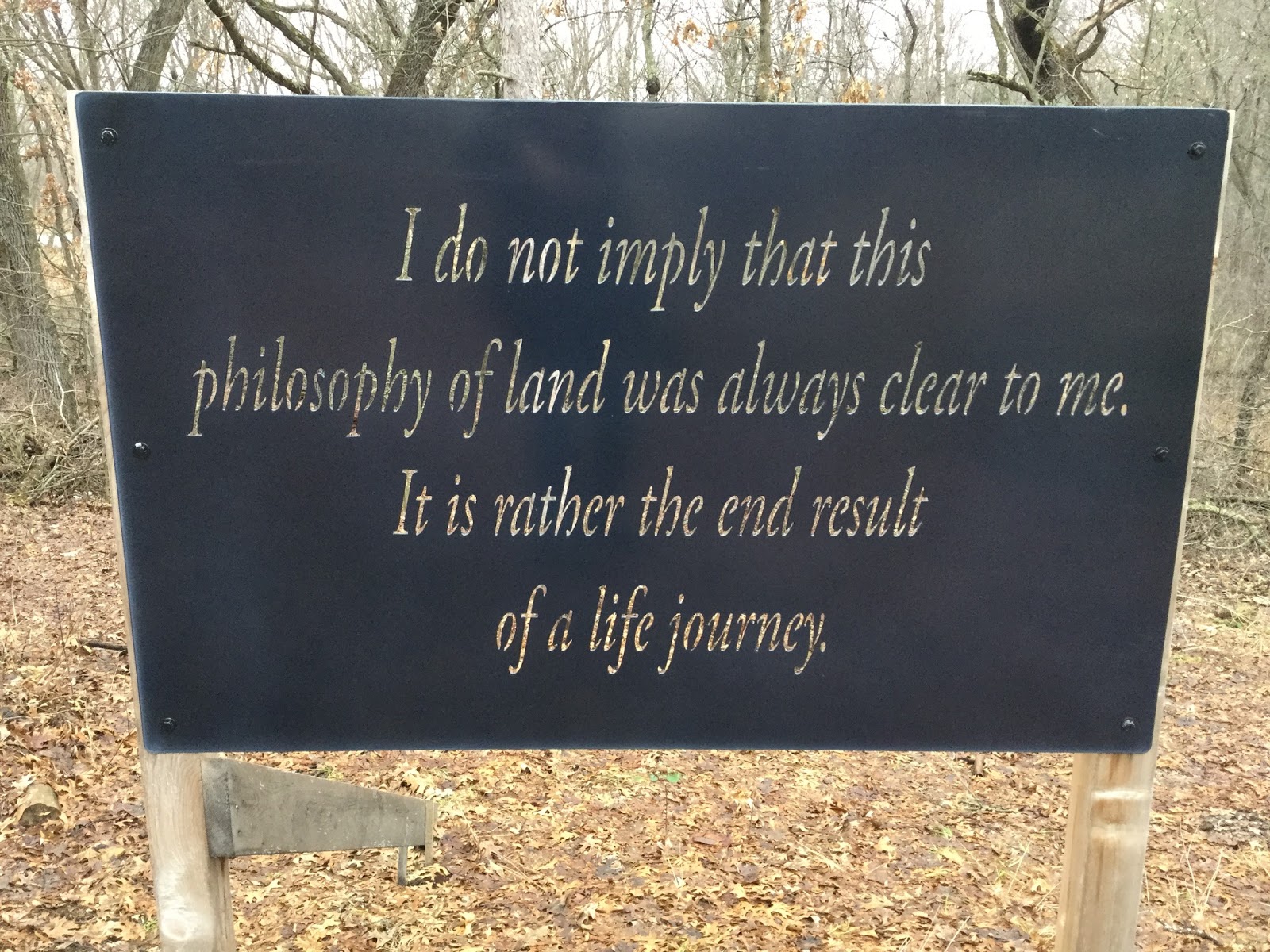
Thursday Snapshot: Aldo Leopold Foundation

A quote from Leopold on the grounds of the foundation.

Earlier this year we visited the Aldo Leopold Foundation. We had just watched a short documentary about his life and work, Green Fire, at my hometown library and were deeply moved by it. The similarities to my husband's family's efforts to restore habitat on family land struck us, but for me the film reminded me of what is best about my home state and region. There is a great deal that worries me at the moment and many things that I struggle with, yet what brought all of us together in that room was a love for place. It was a kind of comfort then, and my memory of the discussion afterward reminds me that there is good work underway and in many places.

We were also surprised to realize that the Aldo Leopold Foundation and the shack where Leopold wrote his seminal work, The Sand County Almanac, was less than 20 miles away. We drove there the next day along a road I walked as a child with my grandmother and past Pine Island, a refuge I often visited with my family in the fall to take in the vast numbers of geese that paused there on their annual migration.

I read The Sand County Almanac in my final year of university and, like so many others around the world, found that it opened my mind to a sort of common sense approach to living in the world that I had long felt was lacking. Leopold describes the changes in the landscape throughout the seasons as well his family efforts to restore a land decimated by logging and overgrazing. He had come to understand that while these practices were grounded in economics, they were also shortsighted in many ways. His years of experience, the successes and failures, taught him that we needed to work in concert with all parts of nature, even those like the wolf, that we did not like. The resulting Land Ethic is one that is simple but complex and multi-faceted and one that can be challenging to live up to at times. However, most things that are worthwhile doing are similar until we get the hang of them. I'm certainly game to keep at it.


Thursday, April 6, 2017

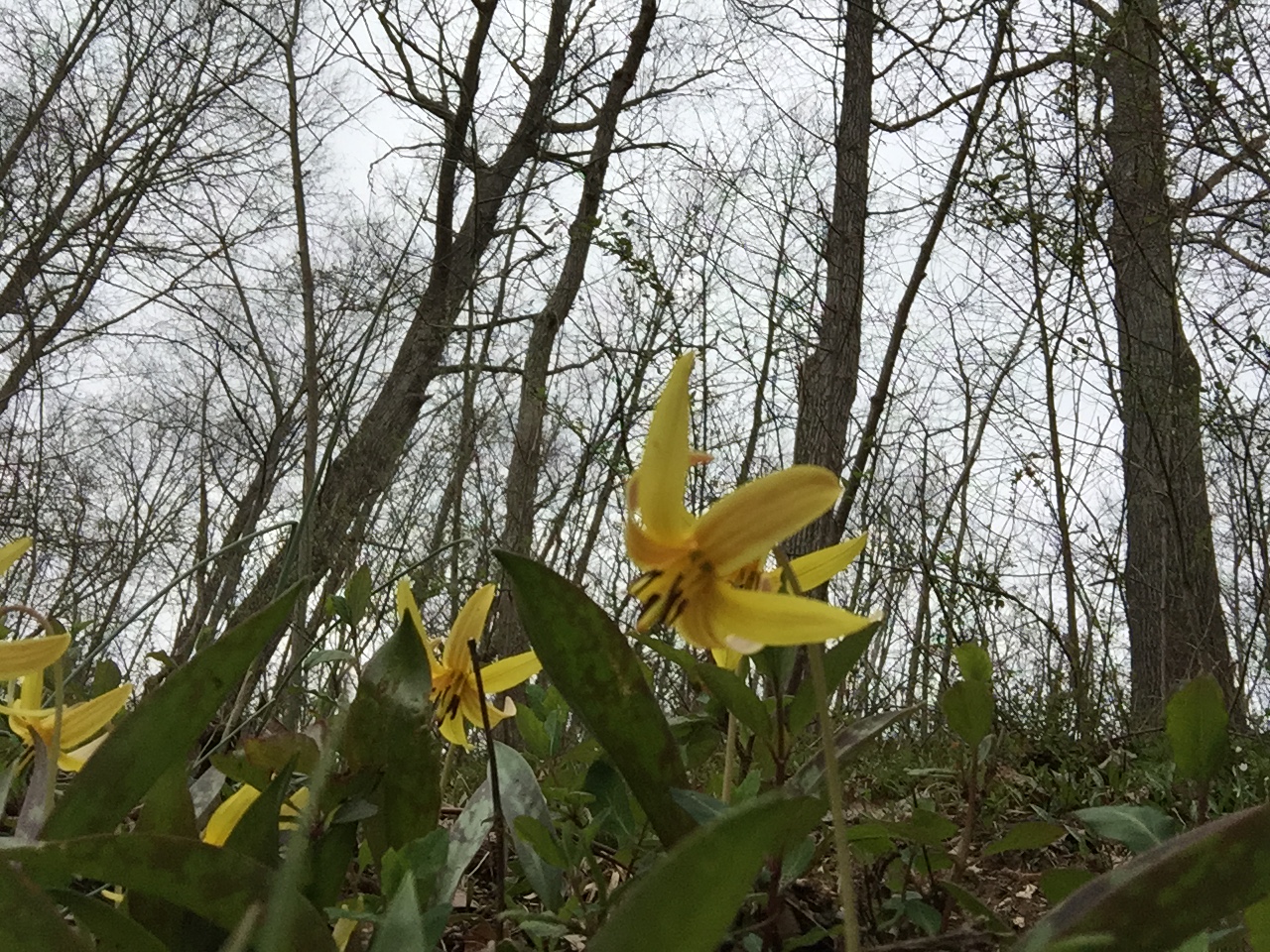
Thursday Snapshot: Trout Lily

Trout lilies along the Potomac River.
I had the great pleasure of attending a writer's conference near Washington, D.C. in March. While the sessions were wonderful, the adjacent regional park was even better. I found myself walking the trails for two hours at a time at the end of each day relaxing from a day of learning and most happily reacquainting myself with native flora and fauna. These trout lilies were among those I had the pleasure of meeting again.

Thursday, March 16, 2017

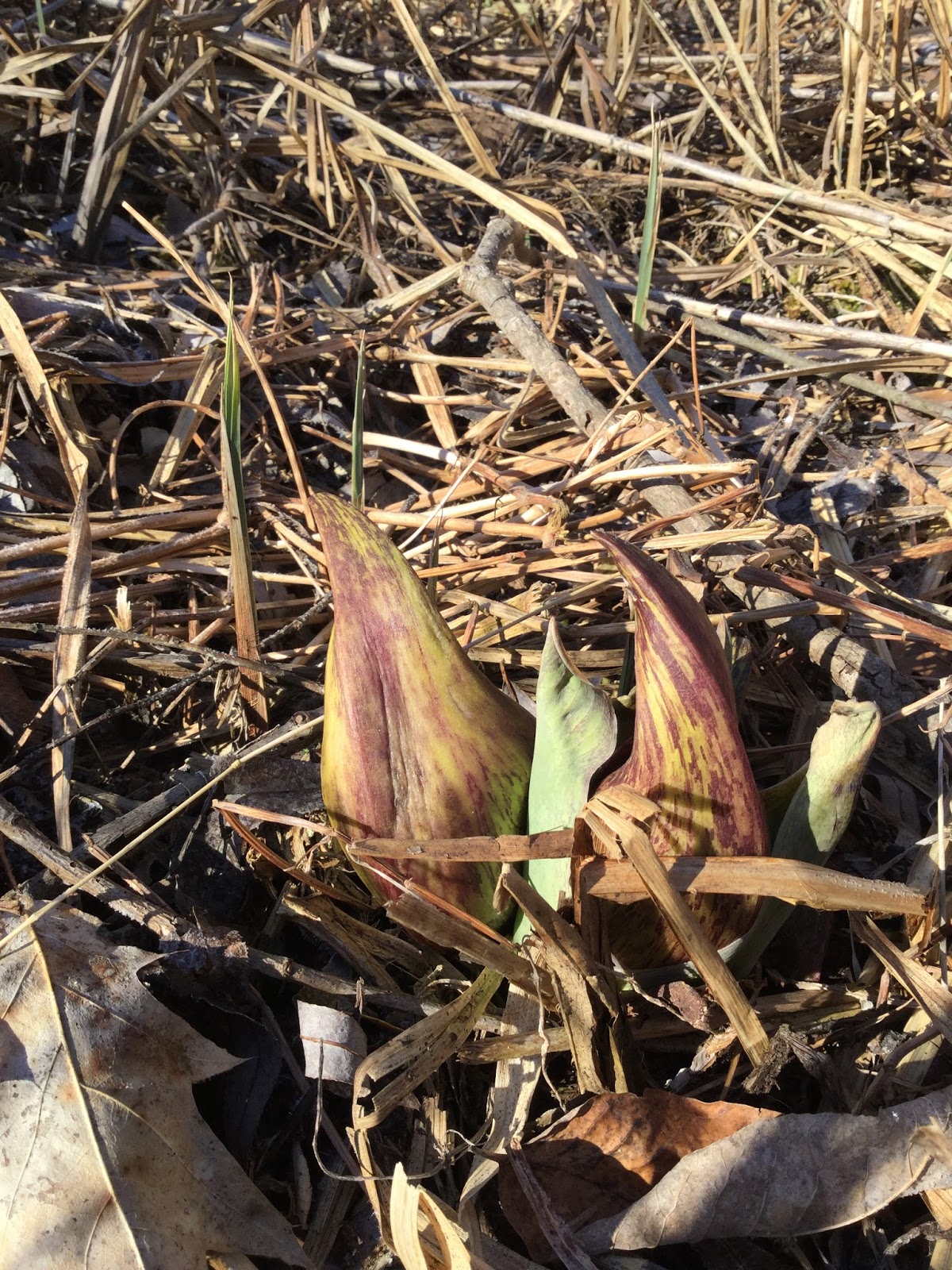
Thursday Snapshot: Skunk Cabbage Seedlings

Skunk cabbage seedlings in early March.
These little lovelies were spotted while out doing some restoration work on family land in Michigan. My aunt spotted these baby skunk cabbage, and since I hadn't seen them for some time it seemed a good opportunity to take a photo.

I know skunk cabbage best as a leafy summer plant, so these little hooded flowers were a surprise. A wee bit of research shows that skunk cabbage prefer to live in wetlands, and that they are some of the earliest flowers to bloom. They are one of the few plants to practice thermogenesis, meaning that they heat the air around and above them. This serves to melt snow and attract their pollinators - flies and other creatures attracted to things that smell like decay.

Thursday, March 9, 2017

Thursday Snapshot: Feeding Minnesota Bears

Only feed wooden bears...

Good friends moved up to the Twin Cities recently, and so we took it as an opportunity to visit them, their new home, and their three cats. While out for a walk, I picked up a bag of Minnesota-made licorice. (It's hard to get good stuff in Japan.)  I met this cute little fellow and his parents along Grand Avenue and thought he might like to try a bite.

Monday, November 14, 2016

Gardening Beyond the Election

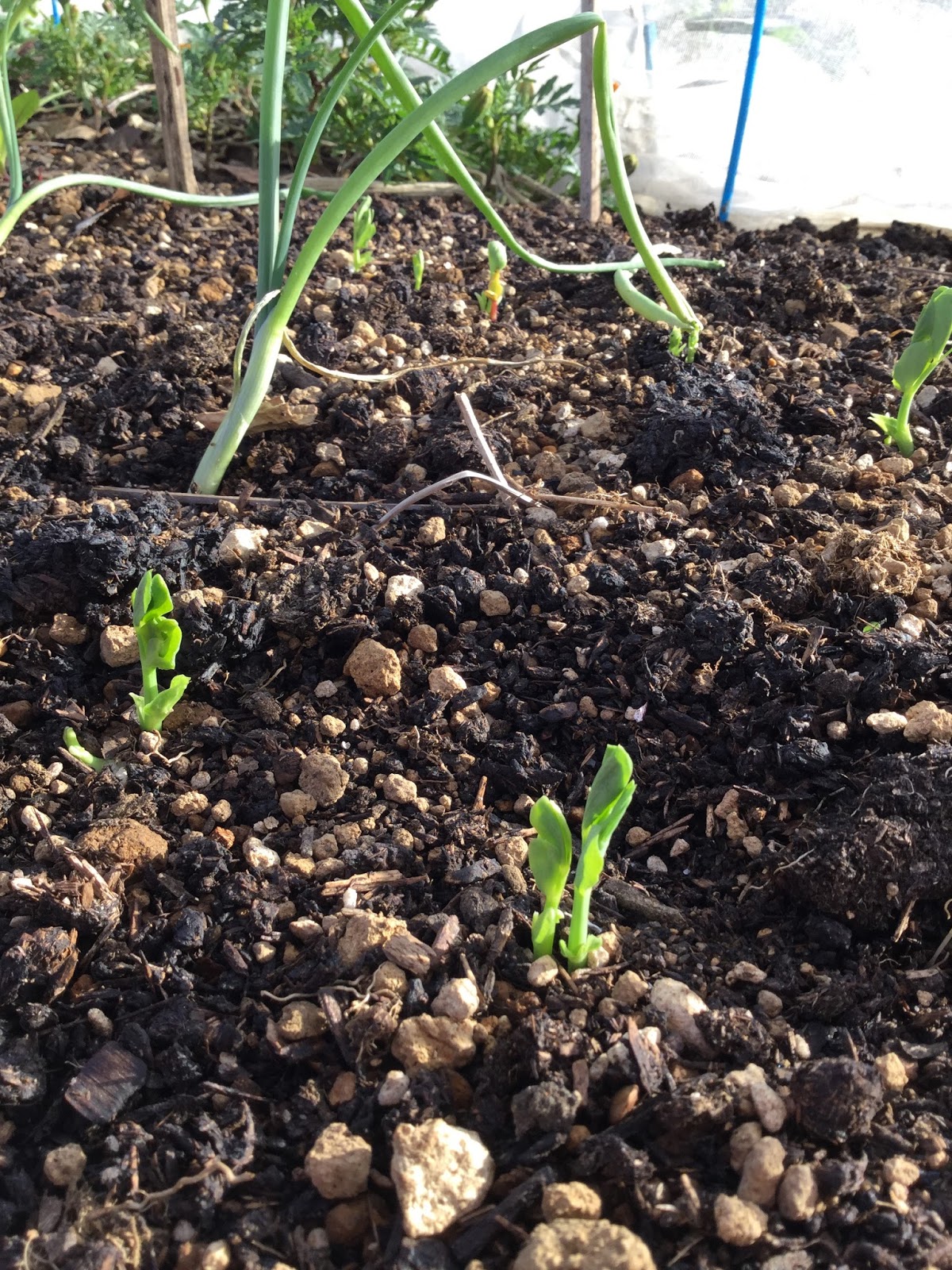
Pea shoots and onions in November.

I wrote the other day that I was as prepared for a negative result from this election as I was for my beet seeds not to sprout. I was mistaken. On some very deep level that I was not aware of, I was prepared for neither outcome.

I am sorry to report that the beet seeds have not yet appeared, which has me worried that my dreams of beet pickles won't come true. They are a taste of home that I love - earthy, rich, and a little bit spicy - but I may have to plant again. I suspect the caterpillar I spotted the other day while watering feasted his way along the rows, working in the coziness of sun-warmed soil. I am working on a solution even as I remain a little bit hopeful.

While I'm not a fan of said caterpillar just now, I know need to understand who he is and why he's there. I'm not angry at the caterpillar, but I am disgusted with a common system for dealing with him. "Just spray," says one of my fellow gardeners, and I say no.

"I'd rather try something else," I reply, and she nods perhaps a bit skeptically. I promise to tell her what I learn.

The caterpillar is there for a reason that I must discover and understand. Ignoring him or blasting him with a chemical does more harm than good to my soil, me, and the other creatures that help me garden. Ultimately, it only makes the caterpillar's offspring stronger. I need to figure out why he is there, what he is doing, and how to work with him. I need to find a way to balance his presence with the presence of others. I don't want to destroy everything because of one hungry critter in my soil.

At the moment, I do other necessary things and think. I weed, work on building up the soil in another part of the garden in preparation for the red onions that will go in the ground on Sunday. I harvest some winter greens, enjoy the sight of the first pea shoots breaking through the soil, prepare the potato bed for February planting, and think about how best to be ready for summer. I map out where the popcorn and tomatoes will go as well as the zucchini, beans, peppers and squash.

Similarly, I was not fully prepared for the result of this election. I could not imagine that so many people would choose the way they did. I wept that day and have each day since, because my vision of a better America, and even of America itself, feels far away. Unlike the garden, though, I'm watching things unravel at home in a steady and horrible way. Like my garden, I am looking for a solution even as I strive to remain hopeful.

Like my garden and my soil, this situation is my responsibility. It is my duty at this time to find a way forward that respects others and protects the integrity of each member of my community. Mostly, I try not to despair as my heart breaks, and I feel my own anger rise. I do not want to entirely give up on my country. There are things about my home I never knew I held dear beyond my family and friends. I am proud of our imperfect history and of many things that are American. I do not want to turn away entirely, even though there are moments when I think it might be a good idea. However, that is another form of despair, and despair leads to inaction or to anger and regrettable action. None of this is helpful.

It's clear to me that we have damaged each other enough, but I don't think it's over yet. I know that we need to come together and collaborate, but I'm still grieving and angry. Soon, though, I need to put that energy to good use finding a way forward. It's up to me to help with that, because I didn't do enough before. I wasn't paying enough attention to what was all around me when I visited home, what I heard again and again from both sides. I know, too, that there are no guarantees. I also know I will find people so entrenched in their beliefs that they will be more obstacle than aid. However, if I don't try, I am casting my vote for destruction. There is still a chance. I don't want to make the same mistake again.

Friday, September 2, 2016

September Farmers Markets in Tokyo and Yokohama

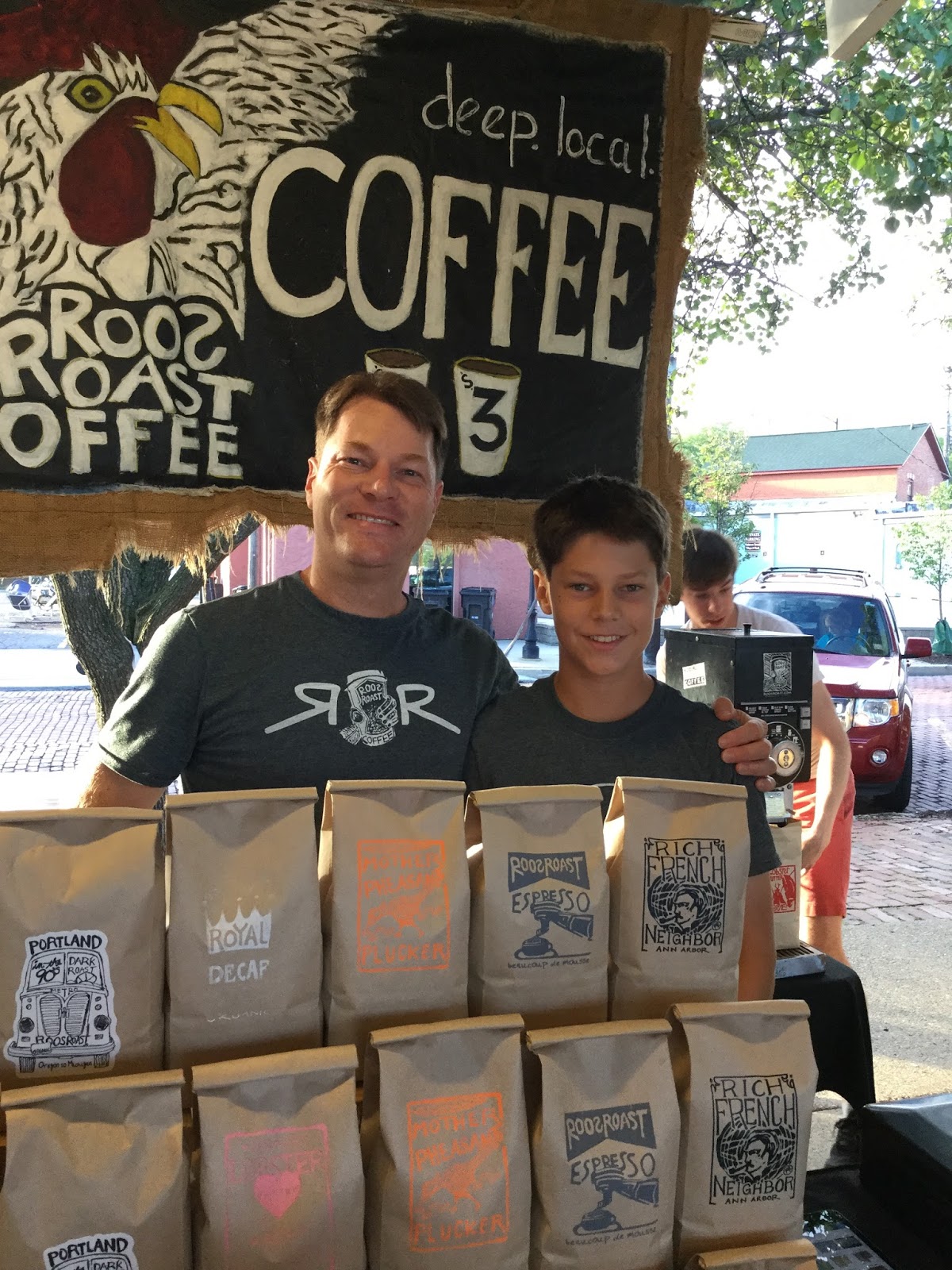
Roos Roast staff cheerful and perhaps caffeinated!
Serving generous cups of their most delicious brews at the Ann Arbor Famers Market.
Ann Arbor, Michigna.
Typhoons come and typhoons go in this blustery month that makes March look like a lamb at best. Don't miss the chance, though, to duck out to one of these great markets and find some of the best the season has to offer. Squash in all shapes and sizes as well as nashi (Japanese pears), grapes galore, and a bounty of vegetables are all just waiting to go home with you and snuggle up in the kitchen. Sound awkward? Don't be silly. It's just plain delicious. 

Sunday, September 25th
I could go wax on forever about how great this market is and how important it is for the future of Japanese farming and global food security. Instead, I'll just insist that folks go and see for themselves what great things the market and these innovative growers are doing. Come find some good food and fun and enjoy!
10am to 4pm, Rain or shine!

Saturday, September 10th and Sunday, September 11th
The newest of Tokyo's farmers markets at two years old, Market of the Sun professes to be one of the largest, and this month looks to be all about the grape. A short walk from Tsukiji Market and its wonderful surrounds, it's worth a stop for a selection of foodly and crafty items that rivals that at the UNU Market.
10am to 4pm
No map, but step out of Kachidoke Station at Exits A4a or A4b

Saturday, September 17th
A market I spotted while riding the train a few years ago on a Saturday morning into the city center is still going strong. That circle of red awnings in front of the Za-Koenji Public Theatre could only mean one thing! Sure enough, I found a small group of area growers and producers, and the bounty surely continues!
11am - 5pm

Saturday, September 17th and Sunday, September 18th
Another great market in the city found with a little help from friends, this one is sure to not disappoint. A small but lively market, particularly on Saturday, it is well worth the trip. Plus, Tohoku growers are on hand sharing their best-of-the-best, so come on out to be part of the recovery and get something good to eat.
No map, but just head out the east exit and look for the green awnings!
10am to 5pm

Saturday, September 17th and Sunday, September 18th
A brand new market opening this month in Yokohama that looks quite promising. Their Facebook page says the Market of the Sun folks decided to start it up, and it's definitely good. Read my review over in Outdoor Japan's Traveler Magazine!
10am to 4pm
Bashamichi Station, Exit 2

Sunday, September 18th
This little gem of a community shindig is one of the best things going outside of the Earth Day Market, and I don't say that lightly. A nice little community affair started a handful of years ago, it blossomed into a full-on monthly festival that just happens to feature Shonan area produce in its fresh, seasonal form as well as pickled, dried, and prepared-hot-in-a-bowl. In summer it turns into a night market, but in fall it will swing back to regular daylight hours. More than worth the trek down to see what's going on!
**5pm to 8pm
Oiso Port Building

Every day
A small local affair featuring Kamakura heirloom fruits and vegetables raised in yet another former capital city, the Kamakura Market is a small but wonderful venue. Head in early to get the best selection and pick up a loaf of Paradise Alley's charcoal infused bread while you're there.
7am until sold out

Every Sunday
Ebisu Market management are going all-out this month and hosting a market every Sunday. They've been recruiting more staff and hunting up vendors, so head on out to be part of the action. A recent visit showed this always lovely market remains charming as ever with an excellent selection of seasonal fruits and vegetables, scrumptious looking snacks, and crafty items. I'd also recommend a trip to Afuri Ramen when you're done for some of the best yuzu tsukemen in town.
11am to 5pm

Every Friday
A charming little weekly market tucked conveniently just outside the turnstile at Futamatagawa Station in Yokohama where a nice selection of fresh, seasonal fruits and vegetables await. Joining them are baked goods, rice, miso, and all the other fixings one might need for the week or just a good snack. Plenty of Kanagawa goodies, too, so be sure to ask!
10am to 6pm
Look for the tables when you step out the gate!

Every Saturday and Sunday
A massive weekend affair that is great fun and features a variety of fruits and vegetables and prepared products from all over Japan. Plus, there's a most excellent selection of food trucks offering everything from salad to zingy curry to roast chicken to falafel!
10am to 4pm

Every Saturday
Back up and running after a refurbishment of the market space, the Roppongi Farmers Market is as booming and bountiful as ever. Don't miss this chance to meet a grower from Tokyo's very own Kokobunji and sample seasonal bounty.
10am to 4pm (Usually. Do check their website for schedule fluctuations.)

Every Saturday and Sunday
Smaller than the UNU Market, Yurakacho features a particular region of Japan each week along with an excellent selection of seasonal fruit and vegetables. Growers from nearby Chiba, Kamakura, and Saitama are also on hand to help fill the larder.
11am to 5pm
Directions: Turn left out of Yurakacho station and cross the courtyard toward Tokyo Kouku Keitan. Look for the fun under the overhang!

Know of a market? Give me a shout and we'll add it to the list!

Friday, August 5, 2016

August Farmers Markets in Tokyo and Yokohama

Fresh veg at my first US chokubaijo!
Montello, Wisconsin

Summer is upon us in all its hot and humid glory. Pick up ingredients for a cool summer meal or tasty beverage (child-friendly or adult) to help keep things cool. Summer crops - tomatoes, goya, eggplant, cucumbers, and onions - abound, and can be paired with all that fresh garlic that should just be emerging from its long slumber now. Do be careful of odd market dates and times as Obon is upon us. Check websites before you go and enjoy!

Sunday, August 7th
I could go wax on forever about how great this market is and how important it is for the future of Japanese farming and global food security. Instead, I'll just insist that folks go and see for themselves what great things the market and these innovative growers are doing. Come find some good food and fun and enjoy!
10am to 4pm, Rain or shine!

Saturday, August 6th**
**Hold on! This month the market is only one day and in a new location. Check out their Facebook page to get directions and see who will be there with what treats!
The newest of Tokyo's farmers markets at two years old, Market of the Sun professes to be one of the largest, and this month looks to be all about the grape. A short walk from Tsukiji Market and its wonderful surrounds, it's worth a stop for a selection of foodly and crafty items that rivals that at the UNU Market.
9:30am to 5pm
**Lalaporte Tokyo Bay (Here's the link to get you to good veg!)

Saturday, August 20th
A new market I spotted while riding the train a few years ago on a Saturday morning into the city center is still going strong. That circle of red awnings in front of the Za-Koenji Public Theatre could only mean one thing! Sure enough, I found a small group of area growers and producers, and the bounty surely continues!
11am - 5pm

Saturday, August 20th and Sunday, August 21st
Another great market in the city found with a little help from friends, this one is sure to not disappoint. A small but lively market, particularly on Saturday, it is well worth the trip. Plus, Tohoku growers are on hand sharing their best-of-the-best, so come on out to be part of the recovery and get something good to eat.
No map, but just head out the east exit and look for the green awnings!
10am to 5pm

Saturday, August 20th and Sunday, August 21st
A brand new market opening this month in Yokohama that looks quite promising. Their Facebook page says the Market of the Sun folks decided to start it up, so it could be good. I'll be visiting to check it out!
10am to 4pm
Bashamichi Station, Exit 2


Sunday, August 21st**
This little gem of a community shindig is one of the best things going outside of the Earth Day Market, and I don't say that lightly. A nice little community affair started a handful of years ago, it blossomed into a full-on monthly festival that just happens to feature Shonan area produce in its fresh, seasonal form as well as pickled, dried, and prepared-hot-in-a-bowl. In summer it turns into a night market, but in fall it will swing back to regular daylight hours. More than worth the trek down to see what's going on!
**5pm to 8pm
Oiso Port Building

Every day
A small local affair featuring Kamakura heirloom fruits and vegetables raised in yet another former capital city, the Kamakura Market is a small but wonderful venue. Head in early to get the best selection and pick up a loaf of Paradise Alley's charcoal infused bread while you're there.
7am until sold out

Every Sunday
Ebisu Market management are going all-out this month and hosting a market every Sunday. They've been recruiting more staff and hunting up vendors, so head on out to be part of the action. A recent visit showed this always lovely market remains charming as ever with an excellent selection of seasonal fruits and vegetables, scrumptious looking snacks, and crafty items. I'd also recommend a trip to Afuri Ramen when you're done for some of the best yuzu tsukemen in town.
11am to 5pm

Every Friday
A charming little weekly market tucked conveniently just outside the turnstile at Futamatagawa Station in Yokohama where a nice selection of fresh, seasonal fruits and vegetables await. Joining them are baked goods, rice, miso, and all the other fixings one might need for the week or just a good snack. Plenty of Kanagawa goodies, too, so be sure to ask!
10am to 6pm
Look for the tables when you step out the gate!

Every Saturday and Sunday
A massive weekend affair that is great fun and features a variety of fruits and vegetables and prepared products from all over Japan. Plus, there's a most excellent selection of food trucks offering everything from salad to zingy curry to roast chicken to falafel!
10am to 4pm

Every Saturday
Back up and running after a refurbishment of the market space, the Roppongi Farmers Market is as booming and bountiful as ever. Don't miss this chance to meet a grower from Tokyo's very own Kokobunji and sample seasonal bounty.
10am to 4pm (Usually. Do check their website for schedule fluctuations.)

Every Saturday and Sunday
Smaller than the UNU Market, Yurakacho features a particular region of Japan each week along with an excellent selection of seasonal fruit and vegetables. Growers from nearby Chiba, Kamakura, and Saitama are also on hand to help fill the larder.
11am to 5pm
Directions: Turn left out of Yurakacho station and cross the courtyard toward Tokyo Kouku Keitan. Look for the fun under the overhang!

Know of a market? Give me a shout and we'll add it to the list!

Monday, December 28, 2015

My essay, Ghosts in My Kitchen, at Metropolis Magazine

Bread and jam are a classic combination of flavor and memory.
One of the unexpected pleasures of living outside of my home country is discovering the deeper meaning behind the food I make. I know that all food has a story and that many of the dishes we eat and their ingredients have tales to tell; however, I didn't realize how important those stories were to me personally until recently. My essay, Ghosts in My Kitchen, at Metropolis Magazine elaborates on that idea and the comfort it affords.

Monday, October 12, 2015

Organic Medicinal Farming Article up at Civil Eats


Inspired by what I read while reviewing The Organic Medicinal Herb Farmer for Permaculture Magazine, I took the opportunity to talk to Jeff and Melanie Carpenter, the authors, about their work and the potential this new field of farming has to offer. Fascinating stuff, if I do say so myself. Check out the full piece over at Civil Eats.

Monday, June 15, 2015

My Essay at Elohi Gadugi Journal


A brilliant sunset over Silver Lake.
Portage, Wisconsin
I occasionally branch out from words on farming and gardening to write about my experience living abroad. Each year my husband and I journey home to the United States from our home in Japan. It is wonderful and arduous all at once. It is physically and emotionally exhausting, but I wouldn't trade the opportunity to meet family and friends face-to-face for anything in the world. You can read the essay here, and I hope you enjoy it.

Monday, March 3, 2014

Reprise: To market, to market

Planting garlic at Frog Holler.
I've no photos from the Ann Arbor farmer's market, so this will have to do!
As we pack up this chapter of our lives, I'm feeling a bit sentimental. Usually we go home in February to see friends and family, but this year we stayed put to have time to wrap things up. My farming life is changing once again, and so I ventured back in time to one of the places that truly inspired me and taught me a great deal about the everyday workings of this growing life. I'll always be grateful. Written in 2008 just before we came to Japan, this is a bit of a window into that time and what I was up to. It was such good fun! - JB

While it was still fresh in my memory, I wanted to recount a usual trip in to the Farmer's Market as a vendor. It's been a great summer, and market is easily one of my favorite parts. While I did tire at times of people asking for plastic bags to go in their canvas bags or wincing at a fair price for an organic potato, I still loved it and am a little sad I won't be going next week. It's an amazing experience and so much fun.

I get picked up a little bit after 5am in the rumblely truck, and we make our way in to the city. The soft glow from the dashboard gives a bit of light to our faces as we make our way from dirt to pavement, and then carefully calculate the turns so as not to spill things from the shelves in the back. Conversation is challenging at that time of the morning, and floats along streams of the ridiculous, mundane, or onto any random story that comes to mind. Anything to keep the driver and passengers awake enough to function when we finally arrive at the market.

Tall yard lights illuminate barns and buildings, and the occasional yellow of a lamp fills a farmhouse window. Old people who cannot sleep and young people who rise to do whatever chores need doing move in the light. We finally greet another vehicle when we hit pavement, but often only one or two. The closer we get to the Interstate, the brightness heightens signifying commerce – gas stations, billboards, parking lots – and the few homes that are visible are dark. The Interstate is busy with other morning travelers. Once we near the city, darkness becomes a soft roof supported by streetlights and stoplights. The mostly empty streets are visible.

As we turn onto the market street, the pavement fills with cars, large and small trucks, and people moving quickly and purposefully. The cobblestone street is narrow here and vehicles and people line both sides. The stalls are lit and the bustle of vendors setting things out and preparing for the customers that will hopefully find their wares and prices irresistible. We move slowly as we circle the block.

Each week backing the truck in presents a nuanced challenge. The puzzle of vehicles – trucks, station wagons, vans, and sometimes garbage and recycling bins left outside too far from the building by the restaurants inside the small shopping center the market rests against on one side - varies in difficulty. I leap out to help guide the driver all the way back to the corner, moving bins and helping position the truck for easy unloading and loading and to not block a footpath. After what feels like forever and always with my heart in my mouth, the ignition is switched off and unloading begins.

Boxes of lettuce, beets, cauliflower, broccoli, salad mix, three kinds of kale, collards, celery, peppers sweet and hot, potatoes, winter or summer squash, yellow and green beans, cucumbers, carrots, four different kinds of basil, two kinds of parsley, sorrel, arugula, dill, cilantro, sometimes mint, strawberries in June, corn in August and September, heirloom tomatoes from late June through early October, and average tomatoes, and Swiss chard. Oh, and garlic, leeks, onions green and storage. And cabbage – green, red, and Chinese. Bok choi, too.

Then come the tables, and the milk crates for making a main table, the side table when we need it, and the stocking table in back. Bags paper and plastic, and the scale. Two signs – one that hangs and one that sits behind against the tree – to signal our presence and our practices, and finally us. Pint and quart containers are filled with potatoes – red and white, tomatoes regular not heirloom, beans, summer squash, and carrots. Greens go on the far end with their bunched stems to the customer for easy picking – curly, dinosaur, then Russian kale, Swiss chard and then collards - followed by beets, carrots, broccoli, cauliflower, and celery – plant or root, if we have it. Then quarts of beans nearly overflowing but not quite, line up and are stacked to tempt with their bounty, pints and quarts of potatoes red and white, large and small, followed by summer squash and cucumbers in season. The peppers jumble together here, too, with their greens, reds, and yellows, while the habeneros, cayennes red and purple, seranos, jalapenos, and tiny Thai burn quietly in a quart for 25 cents each. The watermelon sit heavily in back sending forward only one or two representatives.

Multiple varieties of lettuce heap onto the table and drip down the sides. Buttercup, oak leaf red and oak leaf green, rose lipped green ruffles, and romaines all ready for the taking. The herbs go next to them, sometimes identified with signs, and sometimes without. (Each Saturday Italian parsley has an identity crisis as many people assume it is cilantro, and then set it down again when they hear it is not.) The fish bowl of salad mix signals the freshly snipped tubs are still full, and then the garlic hugs the corner of the table. Heirloom tomatoes, stem end down, array themselves – Striped Germans, Brandywines, Roses, Purple Cherokees, Black Crim, Green Zebras, Amish Pastes, Voloklovs – to tempt and delight the curious and the connoisseur. (These are all but a bittersweet memory now.)

And then we wait. In the lull we greet those in the stall next to us, talk with other growers, and run to the restroom. We drink the last, cooling dregs of coffee or tea. In summer, the sky is already lightening, but now the darkness hangs over until nearly 8am.

As the light increases, so does the flow of people. Early morning shoppers are more intent, quiet, and tend to be a bit older. Later shoppers float along to find a good price and see what the market offers, but our regulars simply arrive and move along the table filling their bags. New buyers come when they see something interesting like celery or celery root, and they suddenly must have it. Beets enjoyed a burst of fame this summer after good press in the New York Times, and we still struggle to keep the table stocked with them. Carrots, too, fly off the table, and curly kale almost never returns to the farm. Garlic, onions, leeks, and broccoli are never seen again along with the beans and strawberries.

Our speed also increases as the morning moves along, until we do nothing but stock the table, tally numbers, fill bags, and make change. We hear how someone cooks something (like celery root, my latest mystery vegetable) or discuss how to cook something they have never seen before but are still drawn to purchase. But mostly we are steady movement, flowing from table to table, task to task, and somehow never much running into each other or knocking down boxes.

The light increases and the air warms. The sea of people flows around us with apples, strawberries, raspberries, blueberries, peaches, pears, watermelon, flowers in bouquets or pots, coffee, pastries, eggs, and meat. They leave the stream to stop and look, ask for something to be identified and about prices. Some wince in what appears to be near physical pain, others voice their disgust at the cost. Others feel no qualms in telling us about their dissatisfaction with the appearance of a vegetables natural growth pattern – the bulging of a tomato so full of sun and rain that it’s skin can hardly contain it or the embrace of a carrot so vigorous in growth that it wrapped around itself – that I wonder what it is they hope for. Others laugh out loud at the potato that looks like a face and marvel at the brilliance of colors in the stalks of Swiss chard. Many return to say they never tasted a lettuce so wonderful or made such fine pesto. Many buy multiples to freeze or can so that the sweet taste of summer is carried to dinner on a cold winter evening.

Our stock dwindles and so one table and then two disappear. The last lettuce sits lonely and limp with a few stray parsley, and pints of potatoes and a small herd of peppers. Bits of the salad mix – stray violas, now flat radicchio, a last curling bit of endive – are scattered about the ground. The truck is again full, but this time of mostly empty boxes and tubs, unless the tomatoes are in full swing. Then the flats of tomatoes seem endless, and return to the shelves if they ever even left initially. Women with heavy accents come to barter. The food we grow moves on to be eaten and enrich the lives of those who purchase it. Ultimately, one of our goals is achieved.

Sleep scratches the edges of our eyes as we sweep up and begin the drive home. Conversation about the market, food, the day, and anything that springs to mind again fills the cab. Hot sunlight pours in to roast us and help sleep try to find an advantage. Turns are not always so carefully made and the spill of boxes is often audible. The tomatoes remain, mercifully, fixed in place and safe.

City streets turn to Interstate to state highway to country roads paved and then dirt. Finally, in a cloud of diesel and waking exhaustion, I spill out the door to the end of the driveway where it all began. Despite the late afternoon hour, I feel as though I just left and the day is just beginning.
Thursday, January 23, 2014

Thursday Snapshot: Michigan Acorns

February acorns lying in wait.


Usually we head home to America for the month of February. This year, though, due to our upcoming move and job changes we're planning to go back in August. Undoubtedly, we are looking forward to all the pleasures of a Midwest summer - swimming, picnics, biking, canoeing, bonfires on the hill, and thunderstorms - and slow sunsets that draw out the stars. However, we won't see so many of these lovely acorns on the edge of the back prairie grass field near our house in Michigan. By August a new crop will be in the works, the squirrels just beginning to think they'd better draw up that winter to-do list.

Thursday, November 28, 2013

Thursday Snapshots: Minamisanriku Garden

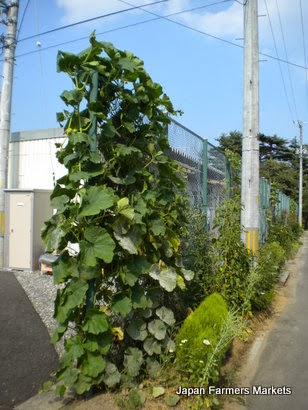
Garden in Minamisanriku, Tohoku.
Today is Thanksgiving in my home country, and I pondered for quite some time about what photo to put here. I'm homesick this year for the holiday more than I ever have been in our nearly five years here. I can't put my finger on exactly why, but my heart pines to be with all sides of my crazy, loving, and weird family. 

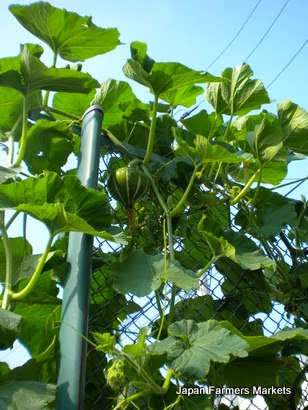
Close-up of the squash.
However, I also thought about others who would give anything to be with those they love. That would be folks from Washington County, Illinois, recently devastated by tornadoes, people in the Philippines ravaged by the recent typhoon, and those still living, literally, in the aftermath of the 2011 triple disaster. My heart goes out to all of them today and always, and while I know they grieve and pine, too, they also find hope and carry on as best they can.

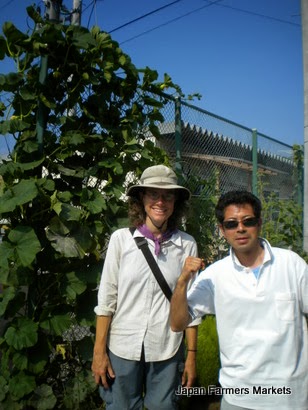
Me with the genki gardener!
And here's one gardener I had the pleasure of meeting this summer while volunteering in Minamisanriku. Settled on a high hill he lives in temporary housing and grows his vegetables along and up a chain link fence just out his back door. I know temperatures have dropped since these pictures were taken and the squash have long since been consumed, but it still inspires me. And it makes me thankful to know those I love are just a phone call away.

Thursday, August 22, 2013

Thursday Snapshot: My First Garden

A snapshot of my first garden in Michigan.
Spring, 2002.
We moved to rural Michigan in the spring of 2002 after I finished graduate school. An old farmhouse on family property stood in need of inhabitants, and we wanted to give country life a go. Family and friends supported my new-found interest in growing and preserving food, lending books and spending steamy afternoons preparing tomatoes for canning. I killed some seedlings and managed to see others through to the first hard frost. I learned to make pesto and dreamed about making jam. The next year the garden, literally, jumped the fence. I grew my first popcorn and squash and made forays into the world of canning. It was spectacular fun that I obviously haven't been able to give up.

Thursday, August 15, 2013

Thursday Snapshot: My Dad and Gooby

Dad and Gooby.
February, 2011
I don't often share pictures of a personal nature here, but my Dad has a birthday this month. We haven't been able to be home with him to celebrate in a long time. If we were there, there'd be brats on the grill, euchre around the table, a fair bit of trash-talking, and best of all, my Dad's laugh. It's not a belly laugh, but there is a rather 'Ho-ho-ho' quality to it, and to see his face wide with delight is a lovely thing. He's quiet but full of stories, and if you get him at the right time he'll start telling them and not stop. I love that, too. I'm not going to wax on and on about memories of summer afternoons fishing (mostly trout and bluegills) or meals out (Friday Night Fish Fry) or anything of that nature. I'll just say he's a good guy and I'm glad he's my dad.

Here he's pictured with Gooby, our Kazakhstan cat who passed away this February. She was quiet too, but full of her own stories and fun. This picture captures both of their characters rather well, I think, and never fails to make me smile.

Monday, August 5, 2013

A Review of David Buchanan's Taste, Memory: Forgotten Foods, Lost Flavors, and Why They Matter

These days I spend a fair amount of time reading books for review with a few thrown in for pleasure. One of the latter is Taste, Memory: Forgotten Foods, Lost Flavors, and Why They Matter by David Buchanan (Chelsea Green, 2012). After reading an excerpt on Chelsea Green's website, I was so entranced by Buchanan's writing that I bought myself a copy. (Full disclosure: I regularly receive Chelsea Green books for review.)

I read much of it on our flight from Chicago to Tokyo this past March, which speaks volumes about Buchanan's ability to tell a story. The only other author to hold my attention on that interminable flight was Philip Pullman, and Buchanan manged it with nary a fantastical being in sight. Taste, Memory explores what place heirlooms and the raising of them have in this modern world of farming and food. Of particular interest for farmer types like me is his exploration of whether or not it's practical.

Most people, especially anyone reading this, is thinking "Of course it matters." with a few including a why-do-you-even-need-to-ask snort or, at the very least, raised eyebrows. But I think Buchanan's question is extremely relevant. Even as people begin pushing for non-GMO foods and farmers markets expand, those who do the growing face the same outrageous odds they always have.

Farming is hard work that pays little. It's a job done not because one imagines finding fame and fortune, but out of a love for land and food. It's a 24-7 job with an impatient product, only a smattering of days off, and has Mother Nature as an unpredictable business partner. It's easy to see why few people choose the field (pun intended) and why many farmers opt for seeds and crops that grow reliably and with relative ease. 

Heirlooms are old, often traditional varieties grown for flavor and regional suitability. This tomato or peach grows well in this valley. This cucumber is a favorite in this county. Buchanan mentions the Marshall, a nineteenth century strawberry that barely makes it from field to market, but with an incredible flavor. Some heirlooms are disease resistant and others are not. Some may not be pretty but they make a mean pickle or a good pie. More often than not heirlooms are open-pollinated varieties cross-bred by generations of farmers who thought this or that breed mixed with another might prove interesting. Seeds were saved and passed down and over fence lines. The stories are countless and fascinating, and as an avid grower and collector Buchanan sweeps us along with many a tale.

Buchanan also takes readers on various adventures as he explores avenues for turning his passion for heirlooms into a viable business venture. He searches for a legendary cider tree and taste tests experimental homemade ciders. He visits potential farm sites and joins meetings convened for the purpose of selecting fruits or vegetables for inclusion in Slow Food's Ark of Taste. Admittedly, there are times when Taste, Memory feels like a farmer version of Eat, Pray, Love, where we move with the writer through various levels of enlightenment, blah, blah, blah. Despite these foodlier-than-thou moments I still liked it.

Buchanan presents as frank, friendly, enthusiastic, slightly bumbling, passionate, and thoughtful. He admits his mistakes (building a house and garden in the wrong spot) and shares what he's learned (growing for market can be lucrative but reduces the number of varieties he's inclined to plant). He tries to be realistic about making his dream come true, always stepping back to assess what he's doing and why. A tale of a visit with a realtor to a beautiful old farmstead as he searches for land is heart-breaking as he reads and researches and calculates the lingering effects of chemicals on the land. In the end, he makes a very different choice. 

What I liked best, though, about Taste, Memory is that Buchanan's final answer as to whether or not heirlooms are worth the effort is cautiously affirmative. He's a good example of gut instinct mixed with careful reflection and practical thinking. He is a passionate but cautious farmer, a fine example for all of us overly-enthusiastic growers who plant two rows too many or bring home twelve too many seedlings.

We leave Buchanan still finding his way, continuing to set out the stones of the path even as he's walking it, still contemplating the best way to bring these old varieties to life for his customers. His theory is that by sharing these plants with others (by selling them in one form or another) he increases the variety's chance of survival and plants a seed (pun intended) of heirloom passion. He's also increasing the diversity of locally grown edible crops, which can only be a positive thing. His continuing experiment takes a surprising number of forms: nursery stock, smoothies, cider, seedlings.

Buchanan also makes the case that doing things on a large scale isn't the right answer. Old models of large scale monoculture don't work in so many ways for the soil, the farmer, the eater, and the local economy. Monoculture means an eventual need for sprays and fertilizers to fend off disease and pests that can run rampant in such environments. Sprays and fertilizers damage soil, water, and air used by everyone above and below the soil including wildlife, pollinators, microbes, the farmer, and the neighboring community. The very soil the farmer relies on, the gift bestowed by previous generations and Mother Nature, dies. The consumer loses another source of local food and flavor.

Buchanan, thankfully, shows a viable alternative. Small diverse farms are more resilient economically and biologically. If one variety of strawberry or peach fails, another is there to fill the space. Buchanan grows enough to turn a profit, but not so much that he stretches himself too thin. Make no mistake: Buchanan is busy researching, weeding, sorting, brewing, planting, writing, photographing, harvesting, preserving, but not perversely so. He's not getting rich, but he's making a living. He's also happy and enjoying himself. Sweet strawberries, fun at the farmers market, and cider sampling – what's not to like?

Wednesday, July 3, 2013

Tokyo Farmers Market Overivew at Just a Backpack and a Rollie

Daikon at the Ebisu Farmers Market.
One of the great benefits of the Blogathon is meeting other bloggers and writers. This year was no different. I am so pleased to have discovered Nancy Thompson and her fantastic blog, Just a Backpack and a Rollie, during the event. Nancy is working on an enviable retirement scheme: fit everything into a backpack and a rollie and go!

Nancy and I traded posts this year for the guest post exchange, and I hope to feature her trips in the future, too. Nancy covered the Portland farmers market for me this time around, but I suspect that wherever she and her luggage land next there will be a market that I hope she will be glad to tell me about.

Meanwhile, here's my post about Tokyo's farmers markets for her!

Tuesday, June 25, 2013

Portland Farmer's Markets: Guest Post

One of the great things about the Blogathon is meeting other writers and bloggers. Nancy is a fellow writer and traveler and farmers market lover from Portland, Oregon. We swapped posts about market fun today, which means that now I really want to go to Portland. You can see my post over at her lovely website, Just a Backpack and a Rollie. Enjoy!

See you at the Farmers Market!  For many Portlanders, a trip to a local farmers market is a weekly tradition.   Earth friendly bags, baskets and carts in hand, they head out to meet  with friends, stock up on kale, scapes, and pea tendrils, pick a peck of peppers and sample the wares from apple cider to tasty tarts.
Portland Farmers Market - Eat Local
At last count there were more than 50 markets spread out across the Portland area.  Most open in early May and run through October.  Talk about bounty — we have dewy-fresh produce on offer somewhere every day - it's like living in the Garden of Eden, without the guilt.

Hubs and I visit like to "shop around" and we've been known to haunt more than one market on a weekend and even stop in on a Wednesday afternoon or Thursday evening market.  Sometimes, a trip to the farmers market is our shopping, dining and entertainment rolled into one.
Portland Farmers Market
Last Saturday we loaded the cooler in the back of the car and headed out to the Queen Mother of Farmers Markets - The Portland Farmers Market.  Located in the beautiful Park Blocks of Portland State University, tents are set up under the trees and stretch out over two blocks.  Of course, some vendors come and go according to season, but there are well over 130 vendors at this market offering everything from goat cheese truffles to Elk steaks.  Fresh Salmon, oysters, crab, halibut and tuna abound.   Take home some fiddlehead ferns, fava beans, black kale or gai soi and create something new and delicious for dinner.  We've had some winners and a few losers, but it's always an adventure in healthy eating.
Portland Farmers Market - spring onions
There are tastings of everything from soup to nuts - literally.  With locally made cheeses, pestos, chocolates, pickles, kimchi, jams, wine, beer, or mead to choose from, you can make a meal just sampling your way around the market.  (Yes, we have).   Music?  Of course!  From violins to rock and roll, somebody is playing on every corner.  Throw in a couple of balloon artists, the poetry man, the digereedoo guy with his gaggle of awe-struck kids, cooking demonstrations, hot food vendors, fresh coffee from a bicycle powered cart, lots of tables, grass for sitting, and some very interesting people watching and you can see why, on a sunny Saturday on the first day in June, there were so many happy people hanging out at the Portland Farmers Market.farmersmarketbanjoplayers farmers market violins farmersmarketfarmers farmersmarketfarmerold
Yes indeed, it's farmers market season in Portland and Life is Good.
Now eat up your fava beans and you can have some salted caramel ice cream for dessert.
Cheers!
............


Nancy Thompson blogs about exploring life, retirement and the world with just a backpack and a rolling suitcase.  
She is a blogger, travel writer and a retirement re-inventor.  One of her essays was recently published in 65 Things to Do When You Retire: Travel from Seller's Publishing.  You can follow Nancy at Just a Backpack and a Rollie.

Wednesday, March 20, 2013

Umami: A Taste of Japan in Wisconsin

Umami's sign glowing above the snow.
While visiting the Center for Integrated Agricultural Systems I received a very nice little publication called the Farm Fresh Atlas. Compiled and put out by REAP Food Group, another dreamy food-related organization in Wisconsin. The atlas is more like a local food lovers' almanac with maps. Here readers can find restaurants serving locally foods, farms, farmers markets, shops, CSA's, and more along with their contact information and, of course, a very nice map showing where they're located. Brilliant.

Paging through it over a cup of coffee at Memorial Union (Yes, it was a perfect visit to my alma mater), I noticed the word ramen. I paused. I'm not a huge fan, although I've come to enjoy a good bowl of noodles now and again. But the husband is, and I've met more than one satisfying bowl over these last few years.

That evening, of course, found us at Umami Ramen and Dumpling Bar. We ordered the ramen, tsukemono (a kind of Japanese pickle), and gyoza. It was heaven. The noodles are made around the corner at RP's Pasta, and the bowls come from the Midwest Clay Project literally just across the street. The vegetables, meat, and all else are also sourced locally, and it was a great taste of Japan in America.

Monday, March 18, 2013

A Visit to the Center for Integrated Agricultural Systems at UW-Madison

A photo taken near Greencastle, Indiana.
Strangely, I have no barn photos from Wisconsin.
I seriously considered titling this post "Meeting my People," but thought better of it. Yet, that is exactly what it felt like two weeks ago as I met the folks at the Center for Integrated Agricultural Systems (CIAS) offices. A charming, energetic, and passionate group of people committed to helping farmers, eaters, and businesses interested in bringing those two groups together, I felt right at home as we talked. CIAS runs a variety of programs and events that are helping to build a local food system that also builds economic viability and community stability with an eye to environmental sustainability. I'm in love. I know that's not very professional of me, but it is a good summary of how I feel. (Full disclosure: I am a University of Wisconsin alum.) Go Badgers. And go visit their website for yourself and be inspired!