Showing posts with label gardening. Show all posts

Thursday, August 24, 2017

Thursday Snapshot: Dill Blossom Fireworks in the Garden

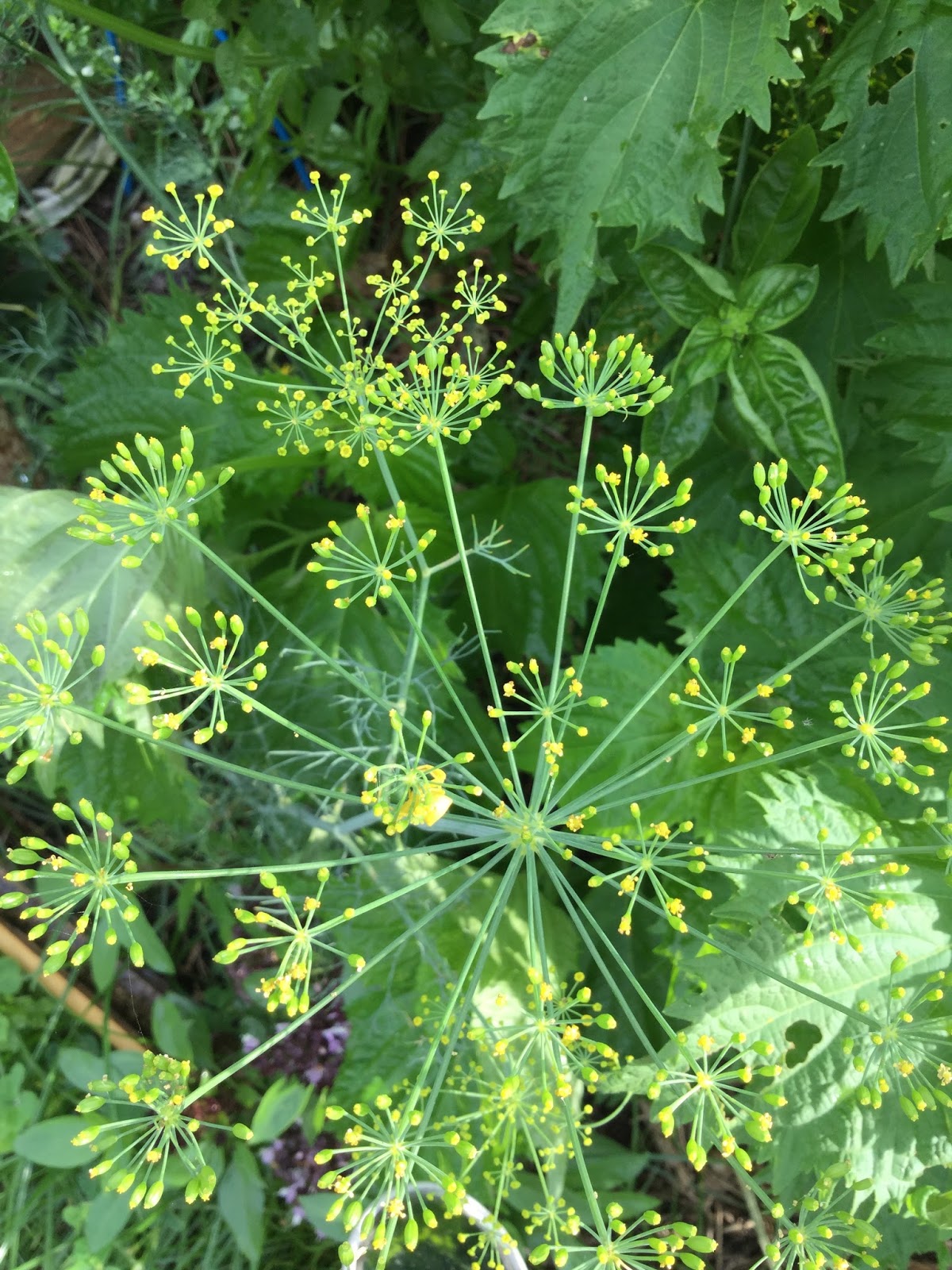
Dill blossoms bursting to life in the garden.

Dill is nearly impossible to find in Japan. It is available at some supermarkets and occasionally at farmers markets, but the price is tends to be high and quantities small. I love adding it to salads as the taste and aroma immediately transport me back to Kazakhstan where it was the primary ingredient in nearly everything. It also makes me think of my mother's kitchen and garden, and the summer days where she would bend the long stalks and seed heads into jars of brined cucumbers that would eventually transform into the dill pickles that graced our table the rest of the year. Growing my own, then, is a pleasure of taste as well as memory. It is also a favorite treat of the swallowtail caterpillars, which I gladly share with them along with my parsley.

The plant pictured here that at this moment resembles the fireworks that fill the skies on these hot summer evenings, is one found at our local nursery. I've noticed over the years that more and more shops carry a nice assortment of herbs such as sage, basil, fennel, coriander, Thai basil, and oregano to name just a few. Even if a balcony is the only growing space available, it is more than possible to create a tidy stock of fresh and dried herbs.

Thursday, May 18, 2017

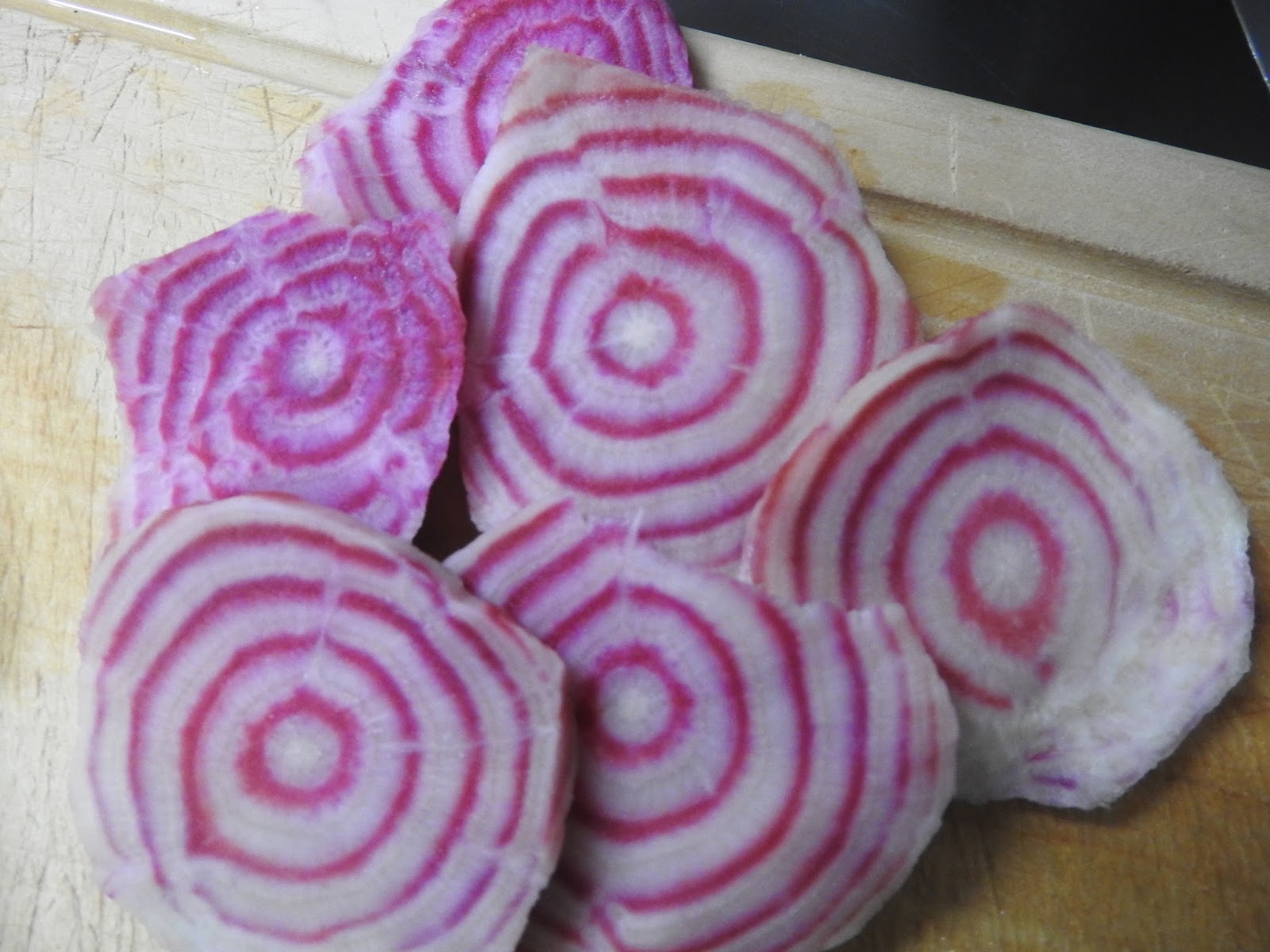
Thursday Snapshot: Chioggia Beets

Chioggia Beets make an appearance.

Awhile back I mentioned some beet seeds that had not yet sprouted. I worried at that time about my soil, the foundation of my garden and all it produces. Was there something lurking there that I needed to know about? Would I ever see the beets of my dreams?

Above is a photo of the beets recently harvested. Imperfect but deliciously beautiful, we have since enjoyed them in salad or raw and dipped in the husband's famous miso mix. My soil, it seems, is not in such bad shape, although I still pay attention to what is happening there. As a good citizen gardener, it's the least I can do these days.

Monday, October 17, 2016

Weed Killing Without Chemicals

This swallowtail caterpillar is motivation to find chemical-free weeding methods.

I have mixed feelings about weeds and tend to use them as mulch or compost in the garden. However, there are plenty of other ways to deal with them, too.

Attainable Sustainable makes a number of great suggestions including mowing, smothering, making good use of chickens, and eating them (the weeds, not the chickens, necessarily) among others. You can read the full post here and my thoughts on purslane, the edible weed, here.

Joan Bailey writes about food, farming, and farmers markets with a little bit of travel thrown in for good measure. Get in touch to learn more about food in Japan or read some of her other work here.

Monday, March 14, 2016

Bamboo Walls for the Garden

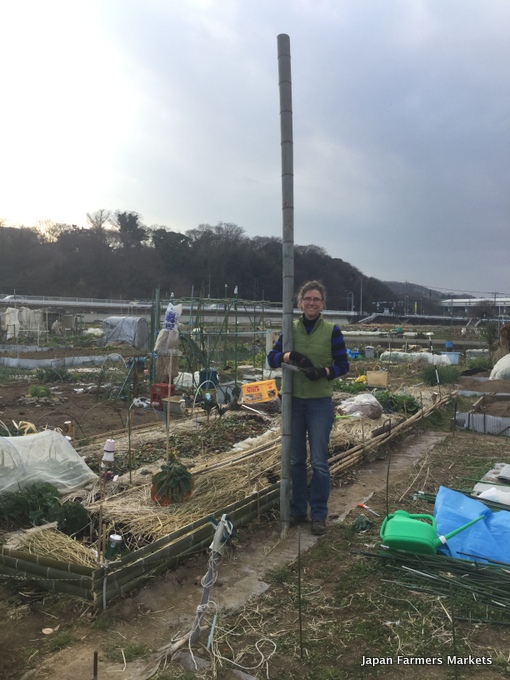
Me, my garden wall, and a bamboo log.
Just before leaving for Nepal we finished a final chunk of the outside wall on my community garden space. I don't wish to till my soil, so I'm using a somewhat homemade method of lasagna gardening. I layer on garden waste - harvested cabbage leftovers, plants at the end of the season, weeds, and trimmings from the surrounding paths - with leaves, composted cow manure, more leaves, and top it all off with rice straw. The occasional round of coffee grounds also makes it in, but the number is negligible.

My goal is to make use of what I have on hand or can find not so far away for free. Bamboo is one thing that appears in abundance. Bamboo would have been found on traditional Japanese homesteads as a source of food as well as a handy building material. It also would have been turned into charcoal, which in turn would have been turned into a kind of insecticide, a home deodorizer, and a soil additive.

These days, though, bamboo runs a bit wild where it still exists. Many of these traditional stands have been cleared to make way for new homes, bigger farm fields, or simply let go. They quickly become impassable masses that have a charm and beauty of their own, but they can also crowd out other species.

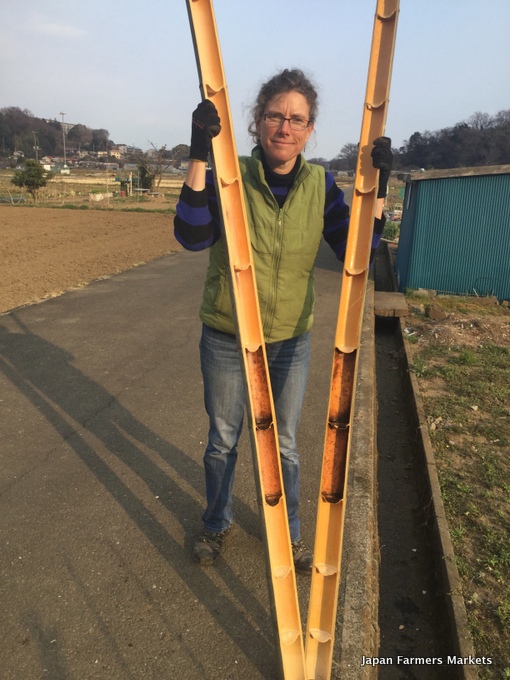
Me and a split log. Isn't it beautiful?!?
We usually split it at least once more to make the pieces for the wall.
We salvage ours from the nearby mountains where crews pass through at least once a season to cut and control marauding bands of bamboo that threaten to overtake the natural forrest. We then split the logs and fashion them into a natural wall for my garden beds. These are held in place by smaller stakes of bamboo that we tie together to hold things securely.

The system isn't perfect. There are gaps between the pieces sometimes, and it doesn't always ride evenly over the surface of the soil. However, all of this pales in comparison to the fact that the fence is a natural material that critters can skitter along happily or even make their nest upon if they wish. (I'm not a fan of plastic these last few years despite its ready availability and cheap price. I think that whole concept a load of non-compostable manure.) It also looks quite nice and is even cheaper than the plastic.

Thursday, August 6, 2015

Thursday Snapshot: Frog in the Garden

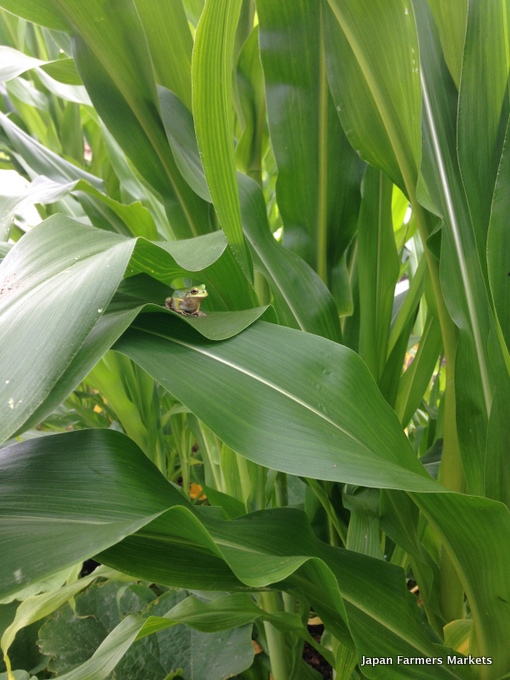
One of my colleagues.

One of the great joys of my garden are the frogs. They are always leaping ahead of me, appearing on a leaf or tomato as I look for what to harvest, or landing on my foot between hops. This little guy is at head height in my popcorn, enjoying the view. He and his compatriots sing a delightful song as evening comes, their chirping rolling from one end of the valley to the other and back again.

Thursday, July 23, 2015

Thursday Snapshot: Possibly Blue-Eyed Grass in the Garden


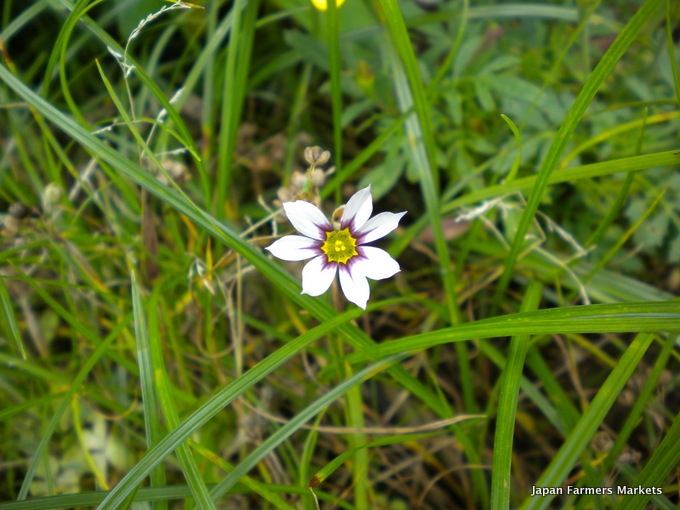
My community garden plot has been full of surprises. There were the tulips, a volunteer onion, and a lovely cherry tomato plant. The best surprise, though, were these little bloomers skimming the Northwest corner. Delicate blossoms that started in late Spring and greeted me even this morning when I ran down to check on things before the heat of the day firmly set down its foot.

A native of the Midwest, Blue-Eyed Grass is a favorite of mine from home. How it got here exactly I don't know, nor do I know absolutely that it is the flower I think it is, but for now I'm choosing to believe that's what it is.

Wednesday, January 28, 2015

My interview with Juliet Kemp in Urban Farms Magazine


Permaculture isn't just for those with vast garden spaces, according to Juliet Kemp, author of Permaculture in Pots, and she's quite right. In the January/February, 2015 issue of Urban Farms Magazine I talk with Kemp about turning balconies, window sills, and back patios into productive permaculture havens and why it matters. You'll have to buy the magazine, but it's worth every cent!

Monday, January 19, 2015

My Review of Around the World in 80 Plants at Permaculture Magazine


I wasn't kidding when I said I review books for Permaculture Magazine. It's a great publication full of practical advice, recipes, and stories of people creating sustainability all around them. (Think Mother Earth News with feet firmly planted in permaculture.) I love it and what they're up to, and heartily recommend subscribing.

I also heartily recommend Stephen Barstow's Around the World in 80 Plants. Barstow, a charming author and talented permaculturalist, shares a selection of the perennial edibles in his collection of more than 2,000 plants. He includes history, recipes, and other lovely tidbits that made this book almost impossible to put down. Barstow has had a very good time exploring, eating, and writing about these plants, and I am convinced this book is his way of sharing the fun. It is also excellent advice for those of us zipping along the front wave of climate change. Read my review here and then pick up a copy for yourself and let the fun begin!

Monday, July 28, 2014

Compost: How to make it

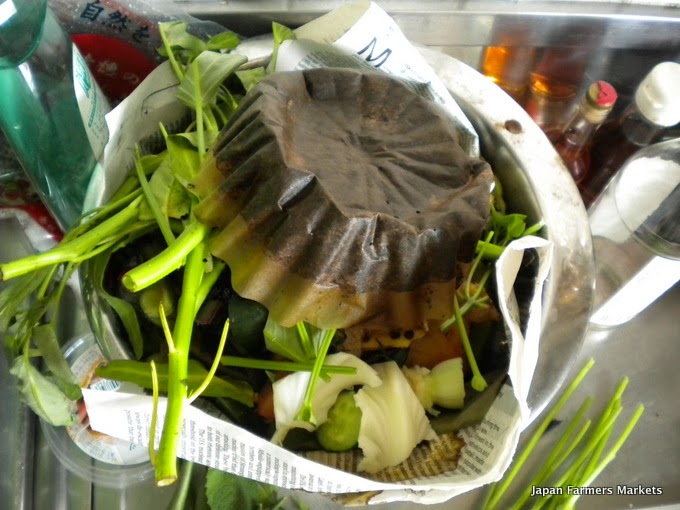
Our lovely compost bowl.
Second in a series on compost - what it is, how to do it, and how to use it. A special entry for urban growers will also be included along with a list of further resources.

Compost usually begins in the kitchen. A bowl lined with newspaper (carbon) gets filled up with vegetable an fruit scraps (nitrogen). This in turn gets transferred to a bucket also lined with newspaper on the porch. The newspaper provides carbon, but it helps absorb liquids, which keeps the bucket and bowl relatively tidy. The bowl is turned upside down to empty it and the newspaper lands on top to make a nice lid. This hides it from the watchful eye of our neighborhood crows and makes it less shocking for visitors.

The bucket in turn gets transferred to a bin near the garden. In Tokyo, my two bins were made of chicken wire and poles, which allowed air and water to move through freely. In Michigan, the bins were made of old pallets, which also allowed air and water to move through freely. Water and air are pivotal for the assorted creatures that will be crafting the compost. Water helps them travel within the pile and keeps them alive, just as it does the plants and the gardener, so they can do their work. Air, of course, is what these creatures breathe. Carbon - newspaper, leaves, twigs, cardboard, etc. - also helps with air and water flow in the pile. These chunkier items then create little pockets that allow creatures move about as they snack, but also allows them to find the oxygen and water they need to survive.

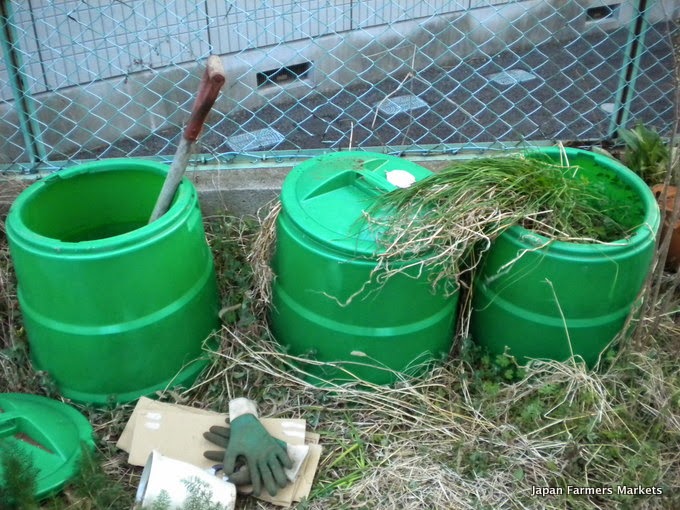
In Japan, round plastic green bins with lids are popular compost bins. These are tidy and attractive and relatively effective; however, their biggest problem is the lid. Water and air, as mentioned above, crucial for the survival of the decomposers, cannot enter if that tight-fitting lid is in place. Neighbors and gardeners alike worry about the contents getting smelly or attracting animals; however, a healthy, active compost bin shouldn’t smell. If their isn’t enough air and water, the activity becomes anaerobic. Decomposition will still occur, but alcohols (of which, according to Lowenfels and Lewis, one part per million will kill plant cells) will be produced. Take the lid off.

Animals may come, but in my experience in rural Michigan, Tokyo, and now Kanagawa, they have not been a problem. If the bin is smelly, animals will be attracted; however, most of them eat in place. Pigeons and other birds frolic and nibble, tamping down the contents and adding their digestive process to the contents. Other creatures may come, but they won’t stay. The garden and bin will be relatively active places, which makes them unattractive homes. If decomposition is going well, the pile should be too hot for comfortable living.

Next: How to use compost
Previous: Compost defined

Monday, July 21, 2014

Compost: A Primer

My compost bins when I arrived at our new place.
Compost is a gardener and farmers gold, and is probably one of the best things we can do for our planet much less our soil. Yet, for many gardeners it remains something of a mystery. The questions I often hear are: How do I make it? How do I use it? What exactly is so great about it? What can I compost? Here’s a quick primer to get folks started on making their own and putting it to good use. 

What is compost?

Compost is essentially a crumbly black soil-like material that results when organic matter (leaves, food waste, fish bones, coffee grounds and the filters, grass clippings, etc.) is broken down by assorted organisms living in the soil. The process tends to be rather slow, but like many good things, it is worth the wait. A teaspoon of compost, according to Lowenfels and Lewis in their classic, Teaming with Microbes, contains “up to a billion bacteria, 400 to 900 feet (150 to 300 meters) of fungal hyphae, 10,000 to 50,000 protozoa, and 30 to 300 nematodes.” While that might sound a little scary, it shouldn’t. Healthy soil is very much alive with all sorts of things that quietly go about their business, literally and figuratively creating the foundation for our lives. Compost also comes with other critters like worms as well as the assorted minerals and nutrients plants need to lead healthy, robust lives. (Here when I say plants I don’t just mean vegetables, but I’m also talking about trees, grass, flowers, shrubs, and herbs to name but a few.) It is a life-giving substance that teems with life itself. It is easily the best thing a grower at any scale can give to their soil and plants.

What to compost?

Technically, any organic material can be composted. This includes coffee filters, newspaper, cardboard, kitchen scraps, tea bags, paper plates, grass clippings, garden waste, and fish bits and bones. Old cotton and wool rugs and t-shirts, too, have found their way to my bin with good effect; however, it is worth noting that these were bins set in the soil. Certainly, there are those who would have a longer and a shorter list than that, but for my purposes these items work well. I do make certain exceptions at different times, such as using garden waste and grass clippings as mulch, but that is just another form of composting in a different place.

There is a great deal of talk about C:N (Carbon to Nitrogen) ratios in a compost pile that can seem intimidating to beginners. Carbon comes in the form of leaves, woody stems, momigara (rice hulls), soba hulls, straw, as well as newspaper and cardboard. This keeps the engines running, so to speak, of the decomposers in the soil. Just like runners before a race, the decomposers use the carbon in the soil to keep their energy levels steady. Nitrogen goes in as fresh grass clippings, kitchen waste, and urine. It helps the decomposers make the enzymes and proteins that let them process the organic matter.

If there is too much carbon, the microbes use up all the nitrogen and can’t produce the enzymes and proteins to break down the carbon. The breakdown process will slow down until the balance is restored. Too much nitrogen, and the microbes will focus on eating it and leave the carbon for later. A balance then, is needed to keep the system running.

Composting is an art as much as a science, so being overly fussy about how much of what goes in isn’t necessary unless the gardener wants it to be. Lowenfels and Lewis among others offer excellent advice on tailoring compost for specific purposes, such as trees versus vegetables versus grass, which is worth knowing but doesn’t have to be strictly followed. Gardeners should simply begin and see what happens.

Next: How to make compost

Wednesday, April 16, 2014

An Interview with Emma Cooper, Part 2

Today we continue our conversation with Emma Cooper, author and gardener, whose latest book, Jade Pearls and Alien Eyeballs, is due out on May 1st. Emma also graciously did a reading for us, which is another wonderful way to preview her work. You can also read my review. Enjoy! - JB


How did you do most of your research for the historical section? Was it part of your thesis work or other on-going research?

I wrote most of the book, including the historical section, before I went back to university to become an ethnobotanist. In 2009, Carolyn Fry brought out a lovely book in association with Kew, called The Plant Hunters, which is a potted history of plant hunting, and that was very useful for my research. It’s a topic of interest to me, so I’ve done a fair bit of reading on it!

I thought it was utterly fascinating to hear how plants wandered about. It reminded me of something Michael Pollan posits at the beginning of one of his books: did we choose the plant or did the plant choose us? (He was thinking of corn, of course.) It is an idea that stuck with me. What do you think makes these unusual edibles appealing but has kept them from becoming more popular?

This is a very interesting topic, and one I did learn more about during my dissertation research. It’s also a very complicated question. There is no simple answer. The chilli pepper, for example, was very easily adopted into cultures all over the world, and that may have been because its use as a spice was both familiar and highly prized at the time. The potato struggled, and that may have been because it was unfamiliar – the Europeans had no tuber crops at that time. The potato also suffered from associations with its poisonous relatives (although the chilli doesn’t seem to have), and got embroiled in religious arguments. Once it was adopted by the Irish it became a Catholic food, and was therefore not overly popular with the English Protestants.

The Europeans who found the New World and wanted to conquer it had an agenda, of course. They opposed any native foods (like quinoa) that had religious aspects to them, or which were particularly key to a society they were trying to dismantle. And there are still prejudices against ‘peasant’ foods. Vanilla, which was exalted by the Totonac people and demanded as tribute by the Aztecs, had a very different fate. It and chocolate, which was considered divine and used as currency, had no problem becoming popular in the wider world!

There have always been economic factors involved. Quite often new foods would be adopted by society’s elites, and then slowly filter down to the rest of the population as they became more widely available and therefore more affordable.

In Chapter 4 you write: "In short, there's a place for native plants in gardens, but it's not the veg patch." Could you elaborate on that a bit? For me, especially as I'm turning more and more towards permaculture, it seems there is plenty of room for native plants in the veg patch to, for example, support pollinators and stabilize soil. I was really shocked to read that and would like to hear more of your thoughts about that.

We may have different perspectives on this issue because we’re from different places. In the UK, it’s very hard to say what is and what isn’t a native plant. Even the ones that have been here for quite some time only arrived at the end of the last ice age. And we’re a long way from a biodiversity hot spot. We just don’t have the range of indigenous crops that you find in the Americas, for example.

The point I was trying to make in the book is that the native vs. non-native plants debate does not belong in the vegetable patch. Here in the UK, if you tried to grow a kitchen garden of native plants, you’d get pretty hungry. The research shows that non-native plants can be just as good for wildlife, and stabilize the soil and do all the things you want them to do. So my advice is to chose your plants on the basis of their utility, not their origin.

I was also surprised at the lack of photos. Was that just the pdf version?

No, you get the same book content in all of the different ebook formats, and there are no photos. There’s a real tendency these days for people to consume media in lieu of actually having an experience. We lap up cookery shows, but fewer and fewer of us bother to cook. We love nature documentaries, but rarely wander outside. We ooh and aah over photographs of lovely gardens, whilst sitting on a concrete patio and pruning the occasional shrub. Although I describe Jade Pearls and Alien Eyeballs as a kind of guide book to unusual plants, it doesn’t have glossy pictures of them because the whole point is to get people going out and finding them, growing them, eating them. I want to encourage curiosity and motivate people to have new experiences, not spoon-feed them everything and sate their appetite with images. It’s not a coffee-table book. It’s not eye candy. The books I loved most when I was a kid (and I was a real bookworm) were the ones with words, not pictures. They exercise your imagination.

How did you find your contributors?

I put out a call for contributors on the blog, way back in 2010. Some of them came via that, and I asked people I had already encountered on social media. Being immersed in the unusual edibles community, I was already familiar with the main players (on and offline), although it was nice to be able to feature some new faces.

What was the best part about working on this book for you?

The best part of working on the book was reading the stories that people sent in for inclusion. I have contributors from all over the world, and it was fascinating to learn what they considered to be unusual, the plants they were growing and the ways they were learning about new ones. You don’t get that in most gardening books, and even if you know these people on social media, those stories very often don’t come out (or you learn them very slowly).

Why did you decide to go the route of self-publishing? Your last book, The Peat-Free Diet, was also self-published. What's the appeal of that process for you? 

I imagine that there’s a rather niche audience of this book, and that I would have had trouble attracting the attention of a publisher for it. Self-publishing also allows me to stay in control of the process, and to write the kind of books that I want to write. I learn about the process every time I do it (and hopefully get better at it!), and it’s a far more personal journey.

That’s important for this book in particular, because it’s a very personal project. It didn’t start out that way, but because of the way my life went over the last few years, I had to shelve it more than once. At the beginning of this year I felt, very strongly, that I was in a position to finish it and to get it out to the people who might want to read it. I didn’t want it to be languishing on my hard drive for ever more.

And, in a very real sense, self-publishing is what I do. I produce a blog, and a podcast, and all of that I do by myself. Self-publishing a book just feels like an extension of that – a new journey.

Where can people find your book?

For the time being, the easiest place to find it is at Smashwords where you can read a preview of the book. From 1st May you’ll be able to buy a copy there, in whatever ebook format you like, as well. But the book will also be available from various ebook stores, including iTunes and it’s already available to pre-order in the Nook store.

What's your next project? 


There’s actually another complete book on my hard drive that nobody has seen, and I’d like to publish that in due course. And I’d like to do an ebook version of The Peat-Free Diet, which is currently only available as an audio book. But for the immediate future my next project is going to be getting back into gardening, which has been another thing that has been on hold through changing circumstances. I have seeds germinating on the windowsills, and an allotment to cultivate this year, so that’s definitely the next thing on the agenda.
Monday, April 14, 2014

An Interview with Emma Cooper

It is my great pleasure to host Emma Cooper, author of Jade Pearls andAlien Eyeballs, as part of her virtual book tour. Emma graciously sat down with me to answer a few questions about her book, the plants she loves, and writing. And don't forget to listen to the reading at the end! It's really wonderful. Any questions for Emma? Send them along in the comments and I'll share them with her. And on Wednesday, Emma will stop by again to continue our conversation. Don't miss it! - JB

Emma Cooper, ready for action!
What inspired you to write this guidebook? You touch on it in the introduction, of course, but I'd love to hear a bit more about it.

I first started thinking about writing this book in the middle of 2010, and for very personal reasons it was put on hold several times. To be honest, I can no longer remember the first spark of inspiration that led me to develop the concept, but I was (and still am) interested in why people choose to grow unusual edibles. I’d met a lot of interesting people online who were doing just that, and I thought they would have some interesting stories to share.

What were the first plants you ever grew? Not unusual edibles, but the very first plants you grew that inspired you to keep gardening. 

I grew coriander and leaf beet, mint and garlic, potatoes in pots, lettuce and beetroot and some other herbs. I think it was probably the leaf beet that inspired me to keep gardening. It was a plant I hadn’t known about before, that was very easy to grow, and which could easily be incorporated into the type of meals we were eating at that time.

What was the first unusual edible you grew? How did you find it or how did it find you?

Achocha, from the Heritage Seed Library (HSL). This was way back in 2005, and it’s all a little hazy, but I’d joined up with the HDRA (now Garden Organic) to learn more about organic gardening, and found out about their HSL. I blogged at the time that achocha was my ‘top choice’, so I was obviously thrilled to find something unusual to grow. I continue to be an HSL member; in the intervening years I have bemoaned the lack of unusual edibles in their catalogues, but they now offer a lot more that they have collected via the Sowing New Seeds project.

What's the most interesting thing you've learned from growing unusual edibles? 

I find it fascinating that the knowledge regarding our food plants is so comparmentalised, and buried in people’s heads rather than being easily accessible. For example, while I was checking through the manuscript for publication, I was talking to Owen Smith about strawberry spinach, and he told me that you can eat the roots. Which is not surprising, as they are related to beetroot, but it wasn’t something I had come across before. I sent him some seeds, so hopefully he will do some experiments this year and we can all read about them on his blog.

Here Emma does a short reading from Jade Pearls and Alien Eyeballs to intrigue and inspire! 

Monday, April 7, 2014

Jade Pearls and Alien Eyeballs: A Review


The latest book by Emma Cooper, Jade Pearls and Alien Eyeballs (Smashwords, May, 2014), combines two of her favorite topics: gardening and unusual edibles. Cooper, author of four unique gardening books – The Allotment Pocket Bible (Crimson Publishing, 2011), The Alternative Kitchen Garden (Permanent Publications, 2009), Growing Vegetables is Fun! (Dennis Publishing, 2008), and the audiobook The Peat Free Diet (Emma Cooper, 2012) – is an established author and expert in her field. The recent addition of a Master of Science in Ethnobotany deepens what she is able to share on her website and helped spur Jade Pearls into existence.

Cooper states in her introduction that Jade Pearls is meant to inform and inspire gardeners everywhere to try growing unusual edibles. Many are perennials, which makes them easy to incorporate into forest gardens, regular landscape schemes, or anywhere a gardener might want to have a reliable feature. She begins with a short history of global plant movement (from Queen Hatshepsut of Egypt up to modern day plant research in space) that sets the stage for how the unusual edibles later profiled made their way to the gardeners she introduces in subsequent chapters. Even if one is not a farmer like me, the stories are fascinating.

Likewise, the growers she introduces – a mix of amateur and professional (including yours truly) – are as captivating. Some, like me, grow for fun and by accident (plants given as gifts or normal for the new place we find ourselves living) while others (like Owen Smith at Radix Root Crops) research how to grow these plants out of concern for a changing climate or as a solution to other environmental worries. Regardless, there is plenty to learn and inspire. Cooper provides plenty of links to websites, books, and articles making her Jade Pearls an ideal springboard for searching out more information on how to grow some of these lovelies on your own.

Like any good gardening book should, Jade Pearls had me jotting down additions to the list of things I want to read (Stephen Barstow's Around the World in 80 Plants springs to mind) and the list of plants I want to grow (mung beans and the Japanese wine berry) this year or next. It also has me thinking more deeply about perennial edibles native to Japan that could be incorporated into my new garden here in Kanagawa. One minor drawback was the lack of photos (Cooper says she prefers to avoid photos as it forces readers to do some of their own homework. Read more of her thoughts on that next week when she visits as part of her virtual book tour.) It is, though, by no means a deal breaker. Jade Pearls is a very welcome addition to my library and even though it's in electronic form, I expect it soon to be well-thumbed.

by Emma Cooper
Available for preview and pre-order at Smashwords
Officially available on May 1st


Look for an extended interview with Emma next week along with a reading as part of her virtual book tour. Check out the whole calendar for even more fun!

Thursday, November 28, 2013

Thursday Snapshots: Minamisanriku Garden

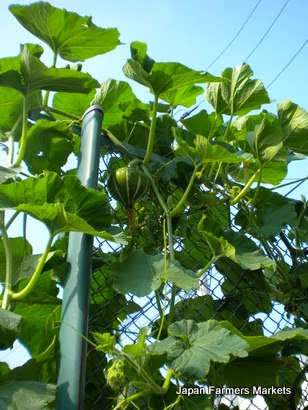
Garden in Minamisanriku, Tohoku.
Today is Thanksgiving in my home country, and I pondered for quite some time about what photo to put here. I'm homesick this year for the holiday more than I ever have been in our nearly five years here. I can't put my finger on exactly why, but my heart pines to be with all sides of my crazy, loving, and weird family. 

Close-up of the squash.
However, I also thought about others who would give anything to be with those they love. That would be folks from Washington County, Illinois, recently devastated by tornadoes, people in the Philippines ravaged by the recent typhoon, and those still living, literally, in the aftermath of the 2011 triple disaster. My heart goes out to all of them today and always, and while I know they grieve and pine, too, they also find hope and carry on as best they can.

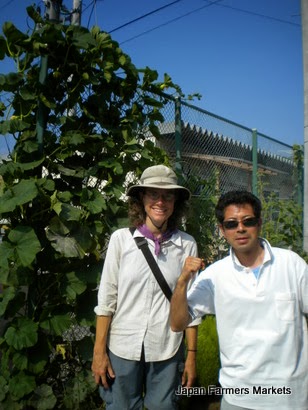
Me with the genki gardener!
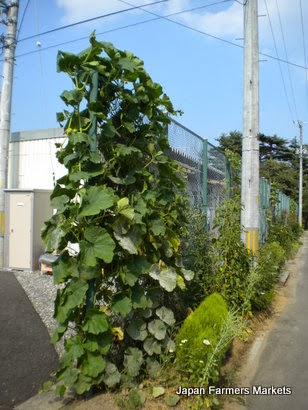
And here's one gardener I had the pleasure of meeting this summer while volunteering in Minamisanriku. Settled on a high hill he lives in temporary housing and grows his vegetables along and up a chain link fence just out his back door. I know temperatures have dropped since these pictures were taken and the squash have long since been consumed, but it still inspires me. And it makes me thankful to know those I love are just a phone call away.

Thursday, August 22, 2013

Thursday Snapshot: My First Garden

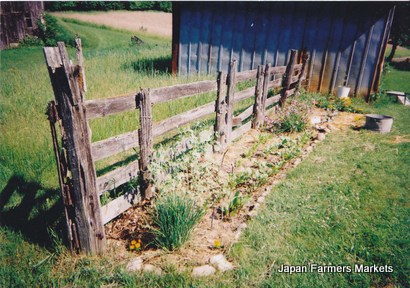
A snapshot of my first garden in Michigan.
Spring, 2002.
We moved to rural Michigan in the spring of 2002 after I finished graduate school. An old farmhouse on family property stood in need of inhabitants, and we wanted to give country life a go. Family and friends supported my new-found interest in growing and preserving food, lending books and spending steamy afternoons preparing tomatoes for canning. I killed some seedlings and managed to see others through to the first hard frost. I learned to make pesto and dreamed about making jam. The next year the garden, literally, jumped the fence. I grew my first popcorn and squash and made forays into the world of canning. It was spectacular fun that I obviously haven't been able to give up.

Monday, April 15, 2013

Living Mulch for Containers

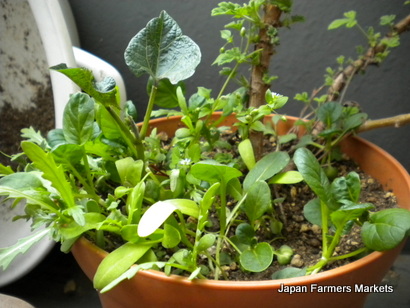
The little riot of green, a.k.a. living mulch, in one of my pots on the balcony.
The same inspiration - spring, packets of seeds for sale everywhere, and the current flow of work at the farm here in Tokyo - that led me to see my egg carton in a new way, led me to read this article by Ari LeVaux in a different light. LeVaux wrote about a beautifully simple idea she had for old seeds: mix them together, spread them on the garden bed in fall, rake them in, and then as they sprout in spring and the rest of the seasons eat them as you need room for new plants. Brilliant. And exactly the kind of thing I've been wanting to hear.

At our farm the standard practice is to use a black plastic mulch that gets laid down by a heavy machine. It works well as a means to heat up the soil in cooler weather, keep down weeds, and retain moisture. But its plastic, requires fuel to be made and applied, and gets trashed at the end of the season. My farmers put it down for me each season after they till in whatever organic stuff I've spread on the soil. I see the appeal, but this year I'm opting out. The farm has grown and my farmers are crazy busy. The plastic and the fuel to make it and lay it out are expensive, and I don't want to cause them undue expense. They would never complain or deny it to me, but I still worry about it. And it's time to find an alternative.

These past years I've also done a fair bit of book reviewing for Permaculture Magazine and reading on my own about farming and gardening. The consistent message is that soil does best when left to its own devices. If I don't till, then the matrix that lives there only gets stronger and healthier. This in turn gives me healthier vegetables, herbs, and flowers, which makes them less susceptible to pests and disease. If I feed this matrix periodically with things like urine, leaves, straw, and my very own compost, it builds up, literally and figuratively, even more. (My garden beds where I've put some of these techniques into practice sit a full ten inches higher than the surrounding land.) If I grow a diversity of plants rather than a monoculture, this gives them an even further boost as pollinators and predators have a place to live and eat while pests and disease have less of an opportunity to settle in and wipe out a crop.

Ok, there's the philosophy. I dug out my old seeds and dumped them all in a jar, per LeVaux's advice. It's not fall, but who cares? They're seeds. I'm a farmer-type. There's open dirt in my garden. I set it next to my compost bucket headed to the farm the next day.

Then I set about repotting a few balcony plants. I'm scaling back pretty severely this year as we will be moving in March, but there are a few old friends and favorites I'm keeping around. As I filled the pots and gently patted down the fresh dirt, the seed jar caught my eye. "Open dirt," my farmer-self thought. Why not?

I opened the jar, sprinkled a handful of seeds over the surface of the soil in the pot, covered it over with a layer of dirt, and gave everybody a drink of water. Experiment underway.

Flash forward three weeks. The seeds have sprouted in a little riot of green that fills my heart with pleasure. Shungiku, scarlet runner beans, daizu, beets, and komatsuna are just a few of the things reaching for the sun at the moment. I'm not sure yet if it's the cosmos or the dill seeds that have sprouted, so I'll have to wait to report on that. Meanwhile, my mouth is watering.

How this will exactly play out once I start eating I don't know. Will I scatter more seeds? Will I just leave it be? How big will I let the seedlings get? Excellent questions all.

My advice so far, though, is to do it. Seriously, why not? For those that don't have a garden, this is a nice solution for old seeds and pots that dry out quickly. Mix in some legumes, i.e. peas, beans, daizu, sweet peas, etc., that will offer up some nitrogen to the soil and their companion plants. Herbs, greens, vegetables, and flowers are all fine. The worst that happens is you get a riot of green and color that could be mostly edible. (Don't eat the sweet peas, please.) Mulch away!


Monday, February 25, 2013

Reprise: Guest post: Pop-up Cardboard Garden


Amber Dohrenwend is a teacher, mother, and author of the Tokyo-based blog, The Cardboard Collective. She designs modern cardboard toys, furniture, tools, and playthings that can be recycled at the end of their life/use. Recently she used a cardboard box outfitted with castor wheels  to transport her children through the Detroit Metro airport in lieu of a stroller.  Cardboard is a material we keep re-imagining she says, using cardboard for gardening just goes to show that cardboard has no limits.

This post went up first on Amber's most excellent blog, and she graciously allowed me to repost here while I was biking in Hokkaido this past summer. Now, I'm toodling about in America, and even though winter is still in the air spring is on the mind for many. It seemed only logical to run it again. Read on, check out her blog, and you'll never see your recycling in the same way again. Mottainai, indeed!


Electra has had her cardboard garden for a month and a half now, and seeing that the cardboard is still in great shape after 6 weeks of rain, watering and sunshine, I thought it was OK to officially let it be known that our pop-up cardboard garden is a keeper.


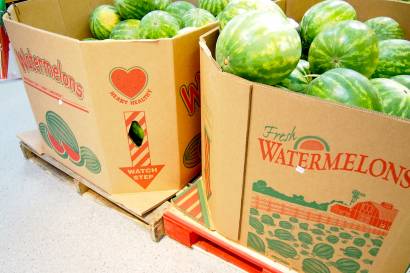
When I was on a cardboard finding expedition at my local grocery store, the produce manager asked me if I was interested in any of the watermelon boxes they had out behind the store. 
Watermelon boxes, I thought, why didn't I think of that before?

Watermelon boxes are made of triple-walled cardboard with a slight waxy finish, and they are super sturdy, even when exposed to rain. This garden isn't intended to last for more than a summer season, but the cardboard should easily last that long. After we finish picking our tomatoes the plan is to distribute the soil onto the other needy beds in our front yard,  and pack up our watermelon box for curbside recycling.


I used a serrated bread knife that I got from a nearby thrift shop to cut the box down to 12.5" high. Then I just positioned the box in a bright and sunny area of our front yard.

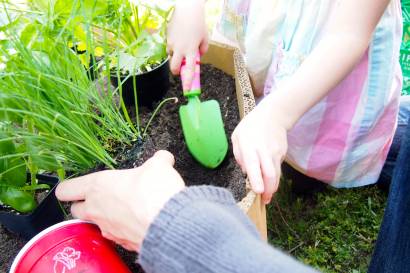
My husband kindly screened several wheelbarrow loads of compost from our backyard and added it to the garden. The last step was cutting off the little triangles of cardboard on the sides that center the watermelon box onto pallets for shipping.


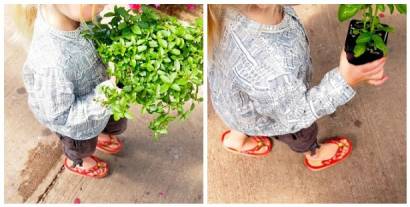
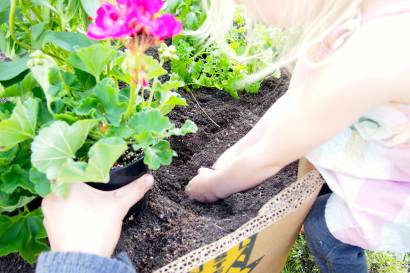
We decided this would be the perfect first garden for Electra so I let her pick out all of her own plants at the local greenhouse. I encouraged her to choose a variety of vegetables, flowers and herbs. She chose cucumbers, tomatoes, chives, basil, cilantro, rosemary, zinnias and her favorite, geraniums.


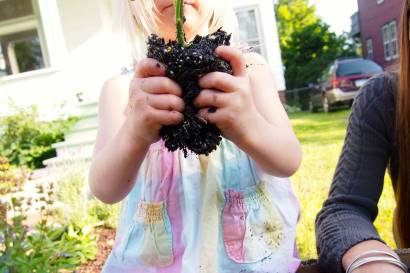
She LOVED handling and smelling her plants and breaking up their roots to get them ready for planting.


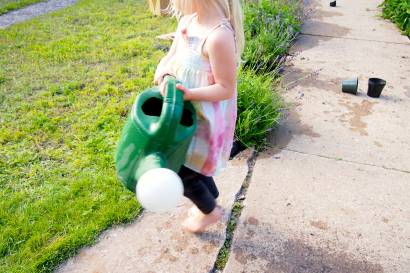
Here she is watering the new crop, and facing a few skeptic neighbors who were sure we were preparing for
 failure.


We watered the garden as needed trying to let it dry out as much as possible to encourage deep root growth and preserve the box. I notice after one month of watering the box is starting to break down a little where the bottom  seam is touching the soil. It looks like it's not to much of a problem at this point, so I'm leaving well enough alone. After a big rain the cardboard gets a little damp and softens. It will harden up as it dries out, so try not to disturb the cardboard too much when it's wet. I'm not promising invincibility here folks, but this IS a means of getting a few more cherry tomatoes into your little ones hands, and a great way to kindle a budding love of gardening.


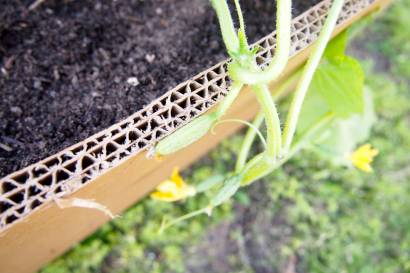
Isn't this tiny cucumber the cutest thing you've ever seen? Seeing it all nestled up next to the side of the triple wall cardboard just about breaks my heart.

**Amber Dohrenwend is a mother and blogger who designs modern toys, furniture, tools and playthings for kids, made from 100% recycled cardboard that can be 100% recycled. Go check out her other great ideas at The Cardboard Collective!

Wednesday, February 13, 2013

Growing New Life in Tohoku up at Ecotwaza

A community garden in Sendai.
Not set up by Peace Boat, but giving comfort, hope and produce, too.
One of the things I really love about the writing I do is being able to discover great stories. I've met some absolutely amazing people from all over the world doing terrific things, seen some extraordinary places, and eaten some of the best food ever.

One of the groups I've been lucky enough to find is Peace Boat. My husband and I volunteered with them in Ishinomaki after the earthquake for a week. It was many months later, but we knew help was still needed and that morale needed to be boosted. It seemed the least we could do for a country and people who have given us so much during our short time here.

My latest article at ecotwaza is part of a series about Tohoku, the region most directly affected by the triple disaster, and what's happening there now. Most stories focus on food and farming, and this one is no different. Peace Boat's project to build gardens for survivors was a wonderful tip from a friend, and a story that I am grateful to be able to tell. Read on for yourself and learn how a garden is more than just a vegetable or two.

Wednesday, January 9, 2013

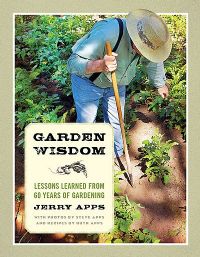
Jerry Apps' Gardening Wisdom: A Little Something for Everyone

Garden Wisdom: Lessons Learned from 60 years of Gardening (Wisconsin Historical Society Press, 2012)  by Jerry Apps charmingly combines his areas of expertise: Wisconsin farm history, farming and gardening. One of three books published in 2012 by this prolific author, Apps takes readers through the seasons on a gently rolling ride of memory and taste all through the prism of his garden. Starting with good basic gardening tips – how to site a garden, prepare the soil, and how to choose what to plant – the book moves into descriptions of Apps' favorite crops. And it is here that the text really begins to shine.

We meet Apps' parents as they worked their land and a kitchen garden larger than some of today's backyards.  We join them for planting, hoeing (the weed is, for Apps' family, the grower's arch enemy), harvesting, and preserving their crops. We glimpse his mother in her chair on a February evening with her stack of “promise books” a.k.a. seed catalogs and pencil dreaming of spring. We watch his father lead a team of horses to plow and find him later, in his nineties, with his trusty hoe still in hand. We learn a method for testing germination rates of seeds using an old wool sock and how to properly process horseradish for homemade sauce - pique the readers interest. We share meals (and thankfully learn recipes) featuring the vegetable in question as it would have been eaten then as well as tasty modern versions, courtesy of Apps' wife, Ruth. Everything from grape jelly to green bean casserole to a very scrumptious sounding navy bean soup is offered up to make the gardener's mouth water. 

Apps' years spent as an agricultural extension agent in Wisconsin and writing a weekly column for the local paper are evident in his easy tone. For my part I would have liked a bit more information on the nuts and bolts of how the farm worked. Apps touches on how the fields were prepared and how, for example sorghum was processed, but this garden-farming geek was left wanting. Such stories and details  would have nicely rounded out his reminisces and the recipes here, and would also be quite timely given the increasing urgency of climate change. A companion volume on these processes would be a welcome (and surely well-used) addition to any gardeners bookshelf.

It's also worth noting that Apps brought his garden to the front yard well before any one else gave such an idea a thought. His account of that – simply placing his garden in the best and most logical spot for it – in 1970's America was not a rebellious statement but rather good common sense put into practice. Apps' perspective on his whole yard as potential growing space should be inspiration for those feeling a lack of viable space for growing.

Garden Wisdom is a touching memoir of a childhood full of practical advice that gardeners today can put to good use. For my part, receiving a review copy from the publisher and reading it connected me once again to my own rural heritage. It reminded me that whether my garden is a series of pots or a patch of land it connects me to my ancestors with every seed planted, every jar canned. Apps provides a perfect nudge for the person interested in growing their own food and learning to process it. Apps' genial tone and knowledgeable yet everyday voice are just the reassuring companions a novice needs. Tucking it into the shopping bag when heading out the door to the local farmers market wouldn't be such a bad idea, either. Paired with a solid reference book like Rodale's Ultimate Encyclopedia of Organic Gardening or Teeming with Microbes, the new gardener's library will be off to a fabulous beginning.

Garden Wisdom: Lessons Learned from 60 Years of Gardening
by Jerry Apps with photos by Steve Apps, and recipes by Ruth Apps
Wisconsin Historical Society Press, 2012.
$26.95
Available from the Wisconsin Historical Society Press.

Monday, August 20, 2012

Guest Post: Pop-Up Cardboard Garden

Amber Dohrenwend is a teacher, mother, and author of the Tokyo-based blog, The Cardboard Collective. She designs modern cardboard toys, furniture, tools, and playthings that can be recycled at the end of their life/use. Recently she used a cardboard box outfitted with castor wheels  to transport her children through the Detroit Metro airport in lieu of a stroller.  Cardboard is a material we keep re-imagining she says, using cardboard for gardening just goes to show that cardboard has no limits.

Amber also kindly agreed to allow me to repost this lovely little homemade gardening ditty here while I'm toodling about in Hokkaido.  It's a brilliant idea that I thought well worth sharing. Read on, check out her blog, and you'll never see your recycling in the same way again. Mottainai, indeed!


Electra has had her cardboard garden for a month and a half now, and seeing that the cardboard is still in great shape after 6 weeks of rain, watering and sunshine, I thought it was OK to officially let it be known that our pop-up cardboard garden is a keeper.


When I was on a cardboard finding expedition at my local grocery store, the produce manager asked me if I was interested in any of the watermelon boxes they had out behind the store. 
Watermelon boxes, I thought, why didn't I think of that before?

Watermelon boxes are made of triple-walled cardboard with a slight waxy finish, and they are super sturdy, even when exposed to rain. This garden isn't intended to last for more than a summer season, but the cardboard should easily last that long. After we finish picking our tomatoes the plan is to distribute the soil onto the other needy beds in our front yard,  and pack up our watermelon box for curbside recycling.


I used a serrated bread knife that I got from a nearby thrift shop to cut the box down to 12.5" high. Then I just positioned the box in a bright and sunny area of our front yard.

My husband kindly screened several wheelbarrow loads of compost from our backyard and added it to the garden. The last step was cutting off the little triangles of cardboard on the sides that center the watermelon box onto pallets for shipping.


We decided this would be the perfect first garden for Electra so I let her pick out all of her own plants at the local greenhouse. I encouraged her to choose a variety of vegetables, flowers and herbs. She chose cucumbers, tomatoes, chives, basil, cilantro, rosemary, zinnias and her favorite, geraniums.


She LOVED handling and smelling her plants and breaking up their roots to get them ready for planting.


Here she is watering the new crop, and facing a few skeptic neighbors who were sure we were preparing for
 failure.


We watered the garden as needed trying to let it dry out as much as possible to encourage deep root growth and preserve the box. I notice after one month of watering the box is starting to break down a little where the bottom  seam is touching the soil. It looks like it's not to much of a problem at this point, so I'm leaving well enough alone. After a big rain the cardboard gets a little damp and softens. It will harden up as it dries out, so try not to disturb the cardboard too much when it's wet. I'm not promising invincibility here folks, but this IS a means of getting a few more cherry tomatoes into your little ones hands, and a great way to kindle a budding love of gardening.


Isn't this tiny cucumber the cutest thing you've ever seen? Seeing it all nestled up next to the side of the triple wall cardboard just about breaks my heart.

**Amber Dohrenwend is a mother and blogger who designs modern toys, furniture, tools and playthings for kids, made from 100% recycled cardboard that can be 100% recycled. Go check out her other great ideas at The Cardboard Collective!