Showing posts with label seeds. Show all posts

Thursday, September 7, 2017

Thursday Snapshot: Stolen Seeds

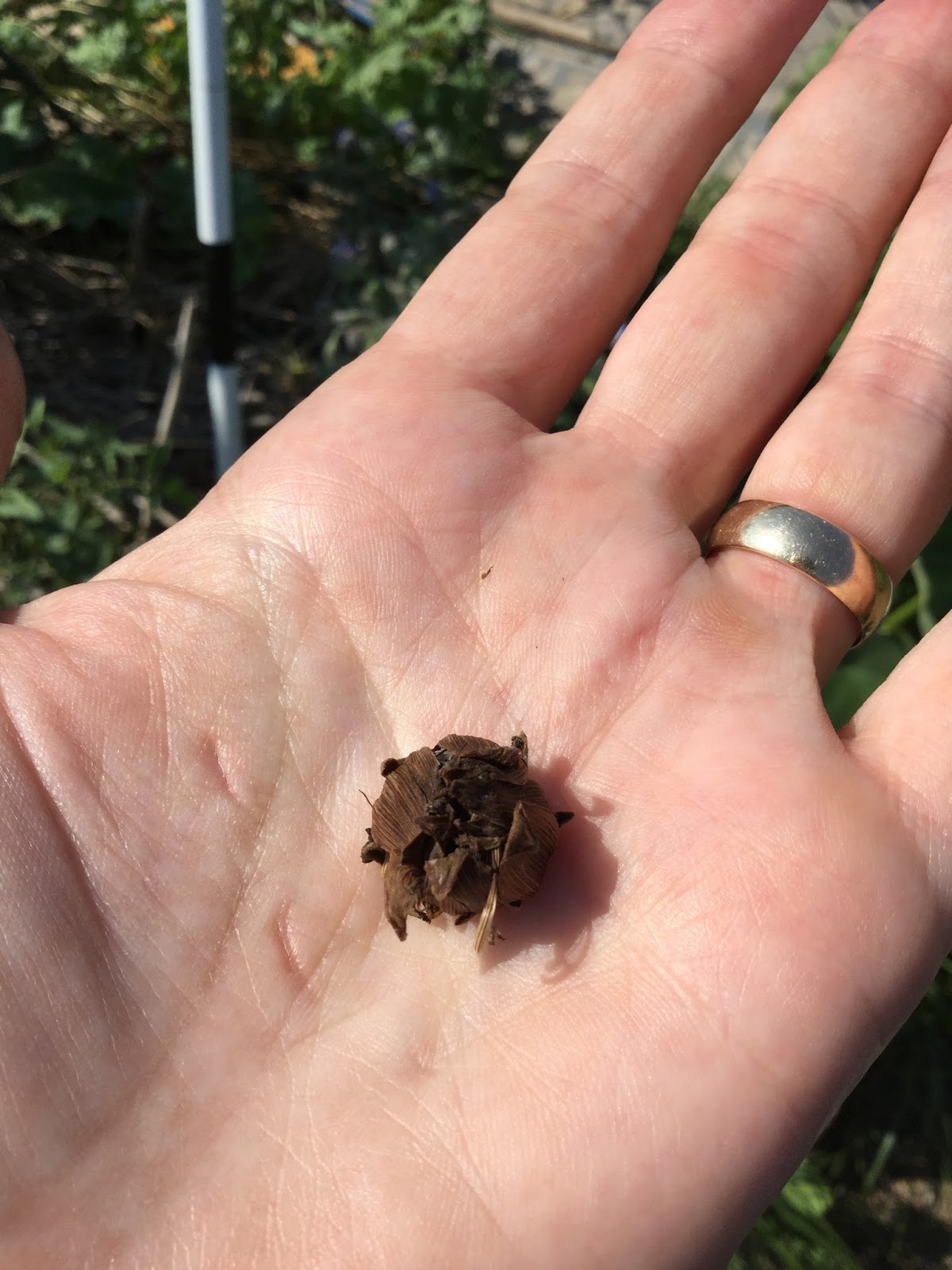
Coreopsis seed head at the ready.

Ok, stolen is kind of a strong word. I happened to be walking to the garden one morning and noticed that a stand of coreopsis I admired had some seed heads. They bloom next to a guardrail along the road and are a cheerful greeter each time I walk to and from my garden. I plucked a head in passing and tossed it into the garden near the rhubarb. On the way home, I grabbed another and tossed it onto the soil near my compost bin. A couple days later, I snagged another and plopped it in a different location in my garden. I felt a little guilty, but my neighbor put my mind at ease.

"Every gardener does that," she said when I confessed my crime one morning when we met while tending our respective plots. So, I grabbed another on my way home and eyeballed a clump of nira that were blooming, too. After all, I'm a gardener, I thought as I mentally marked the location.

Monday, October 10, 2016

Finding Heirloom Seeds in Japan

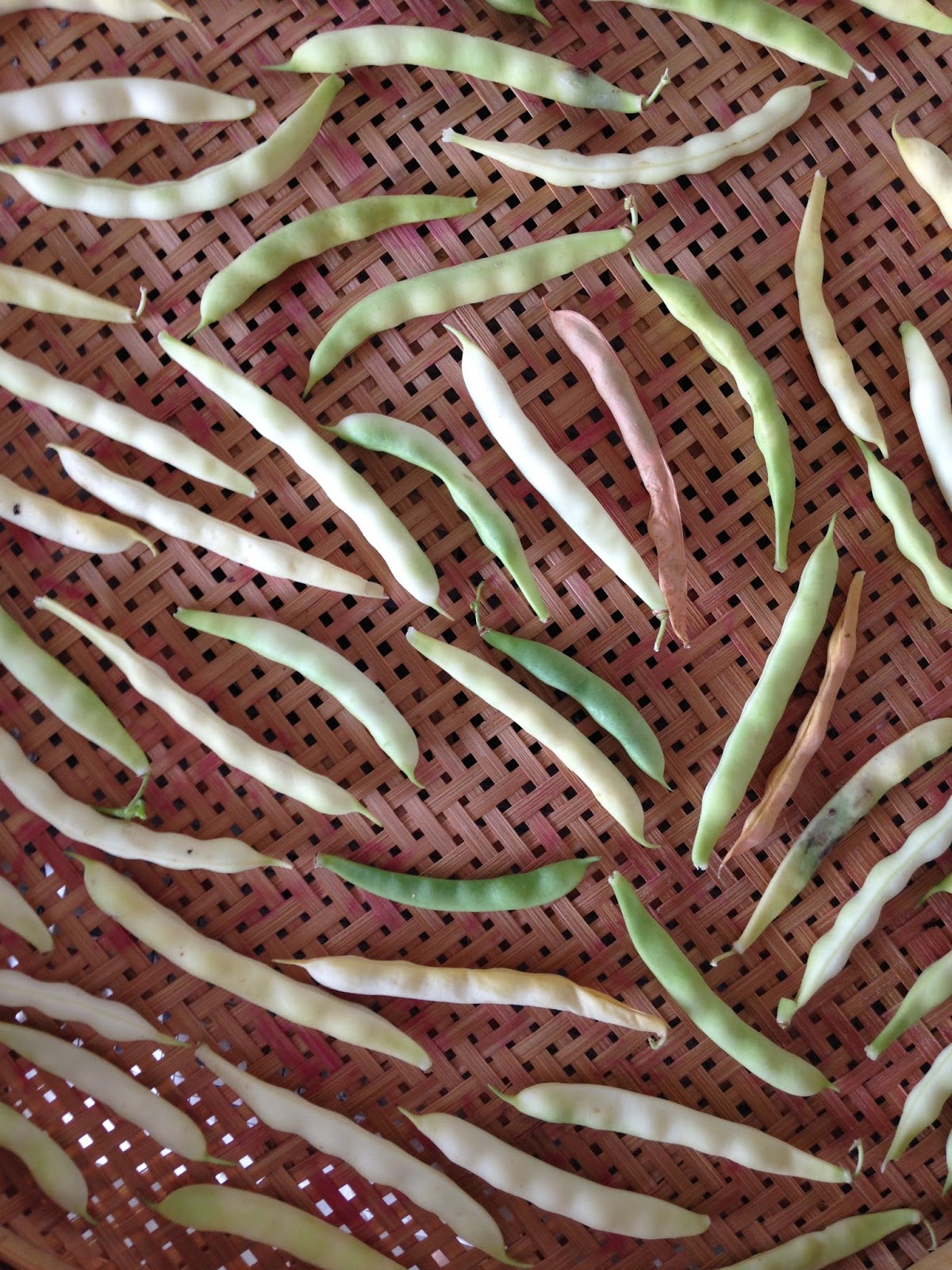
Drying pods of heirloom Hutterite Soup Beans.

Since moving to Japan eight years ago, one of my greatest challenges as a farmer-gardener has been to find heirloom or open-pollinated seeds. The majority of seeds available are not GMO (genetically modified organisms) as Japan, at this point, doesn't accept this material. Most seeds, though, are nearly all F1 varieties.

Heirloom and F1 Varieties
In plant breeding, F1 is the name given to the first generation of a cross between two true breeding parents. For example, if I decide to cross an Amish Paste Tomato with another heirloom variety tomato such as Emmy, in hopes of getting a gold paste tomato, the resulting generation of fruit is F1.

In order to get that tomato of my culinary dreams, I'll need to choose members of that first generation that are headed in a direction I like - early ripening, medium-sized fruit, good taste - and save their seeds. I'll plant them and repeat the process again and again over time until I get the one I want. (I will, of course, be eating my mistakes as I go, which isn't all bad.) The result is a vegetable that I like, that is tailored to my soil and climate, and that I can share with neighbors, friends, and even total strangers who also daydream about a golden paste tomato.

Today, though, F1 often stands for plants that are not the first generation of a cross between two true breeding parents, but rather somewhere further down the line from that original pair. Seeds saved from these F1 hybrids will not grow true. (Seed can be saved and eaten, but it just won't be the same as that first one. Patient gardeners can hack their way through the hybridization process to get something they might want. Those who want to try their hand at that should check out Breed Your Own Vegetable Varieties by Carol Deppe.)

Open-pollinated or heirloom varieties, though, do grow true. If you plant, for example, an Amish Paste tomato, save the seeds, and plant them the next season, an Amish Paste tomato will grow. These varieties have survived and been passed down from generation to generation, literally from hand to hand, because they are reliable, taste good, store well, and are integral to local foodways.

Japanese Heirloom Seeds
Japanese heirloom seeds can be found in Japan through two main organizations. Tane no Mori specializes in organic seeds of traditional Japanese vegetables, but also European and American ones. This seed company is popular with a number of organic growers and producers. They also run a number of events and a monthly market near their home base in Saitama Prefecture.

The largest selection, though, is available from Noguchi Seeds. Also headquartered in Saitama Prefecture, Noguchi Seeds offers the widest selection of traditional varieties I have found yet. Many are Edo yasai (Edo vegetables) that were once common and even famous, but are now not well-known at all.

Other sources I use are asaichi (literally translated as morning market, these are traditional farmers markets) and western-style markets, michi-no-eki (roadside stands) and chokubaijo (vegetable stands). Many of the growers selling at these places continue to save their own seed and grow it. It's worth asking!

Joan Bailey writes about food, farming, and farmers markets with a little bit of travel thrown in for good measure. Get in touch to learn more about food in Japan or read some of her other work here.

Monday, April 15, 2013

Living Mulch for Containers

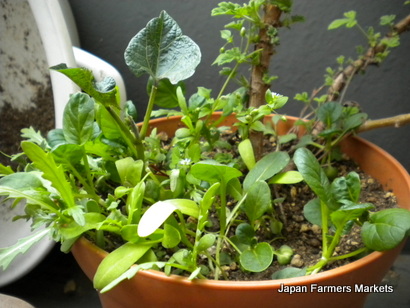
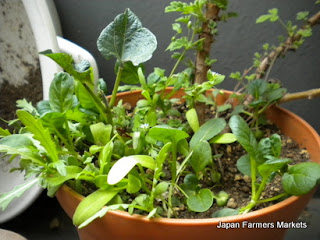
The little riot of green, a.k.a. living mulch, in one of my pots on the balcony.
The same inspiration - spring, packets of seeds for sale everywhere, and the current flow of work at the farm here in Tokyo - that led me to see my egg carton in a new way, led me to read this article by Ari LeVaux in a different light. LeVaux wrote about a beautifully simple idea she had for old seeds: mix them together, spread them on the garden bed in fall, rake them in, and then as they sprout in spring and the rest of the seasons eat them as you need room for new plants. Brilliant. And exactly the kind of thing I've been wanting to hear.

At our farm the standard practice is to use a black plastic mulch that gets laid down by a heavy machine. It works well as a means to heat up the soil in cooler weather, keep down weeds, and retain moisture. But its plastic, requires fuel to be made and applied, and gets trashed at the end of the season. My farmers put it down for me each season after they till in whatever organic stuff I've spread on the soil. I see the appeal, but this year I'm opting out. The farm has grown and my farmers are crazy busy. The plastic and the fuel to make it and lay it out are expensive, and I don't want to cause them undue expense. They would never complain or deny it to me, but I still worry about it. And it's time to find an alternative.

These past years I've also done a fair bit of book reviewing for Permaculture Magazine and reading on my own about farming and gardening. The consistent message is that soil does best when left to its own devices. If I don't till, then the matrix that lives there only gets stronger and healthier. This in turn gives me healthier vegetables, herbs, and flowers, which makes them less susceptible to pests and disease. If I feed this matrix periodically with things like urine, leaves, straw, and my very own compost, it builds up, literally and figuratively, even more. (My garden beds where I've put some of these techniques into practice sit a full ten inches higher than the surrounding land.) If I grow a diversity of plants rather than a monoculture, this gives them an even further boost as pollinators and predators have a place to live and eat while pests and disease have less of an opportunity to settle in and wipe out a crop.

Ok, there's the philosophy. I dug out my old seeds and dumped them all in a jar, per LeVaux's advice. It's not fall, but who cares? They're seeds. I'm a farmer-type. There's open dirt in my garden. I set it next to my compost bucket headed to the farm the next day.

Then I set about repotting a few balcony plants. I'm scaling back pretty severely this year as we will be moving in March, but there are a few old friends and favorites I'm keeping around. As I filled the pots and gently patted down the fresh dirt, the seed jar caught my eye. "Open dirt," my farmer-self thought. Why not?

I opened the jar, sprinkled a handful of seeds over the surface of the soil in the pot, covered it over with a layer of dirt, and gave everybody a drink of water. Experiment underway.

Flash forward three weeks. The seeds have sprouted in a little riot of green that fills my heart with pleasure. Shungiku, scarlet runner beans, daizu, beets, and komatsuna are just a few of the things reaching for the sun at the moment. I'm not sure yet if it's the cosmos or the dill seeds that have sprouted, so I'll have to wait to report on that. Meanwhile, my mouth is watering.

How this will exactly play out once I start eating I don't know. Will I scatter more seeds? Will I just leave it be? How big will I let the seedlings get? Excellent questions all.

My advice so far, though, is to do it. Seriously, why not? For those that don't have a garden, this is a nice solution for old seeds and pots that dry out quickly. Mix in some legumes, i.e. peas, beans, daizu, sweet peas, etc., that will offer up some nitrogen to the soil and their companion plants. Herbs, greens, vegetables, and flowers are all fine. The worst that happens is you get a riot of green and color that could be mostly edible. (Don't eat the sweet peas, please.) Mulch away!

Wednesday, December 14, 2011

A Few Gift Ideas

I do love giving presents. My favorite spouse watches our stock of jams, marmalades, pickles, and shus like a hawk to make sure there is enough left in the larder for us to enjoy as I tend to lift jars out on the spur of the moment for sharing. And this time of year, of course, finds me pilfering our stock left and right. It is a double pleasure to see our shelf space open for future jars of goodness and later see the delight on the faces of those receiving the gift.

So, in that spirit I'm going to share a few ideas for gifts that I would love to receive.

Green Curtain Kit – Give the gift of summer shade with a homemade green curtain kit. Easy to assemble – one pretty pot, some seeds, and a bit of netting – all packed up in a pretty furoshiki, the kit is sure to please. Choose morning glories for their heart shaped leaves and brilliant blue blossoms or the classic goya for a curtain that supplies the main ingredient for scrumptious chample. Cucumbers, gourds, watermelon (a little heavy, but so yummy!) or other vining plants make fantastic curtains, too.

Winter Salad Set – If summer feels too far away, why not consider a few winter vegetables? A wide variety of edibles enjoy winter's cooler temperatures and friends will enjoy a fresh taste of the season. Leafy greens such as komatsuna, mizuna, or spinach adore this time of year as do peas, kabu, violas, and herbs like cilantro and parsley. Head over to a nearby nursery for seeds or even seedlings, a cute pot, and give an edible gift that's green in more ways than one!

Handmade Tokyo – A creatively written work documenting a community workshop examining one of the best and greenest things in this metropolis: its gardens. Braiterman and Berthelsen's work combines photography and text to share and explore green spaces large and small and their meaning to Tokyoites and beyond. Arriving in its own handmade wrapper fashioned from cast-off kimono's, there's no wrapping to worry about!

Tokyo Flower Walks – Sumiko Enbutsu's classic should be in the hands of any resident of Tokyo or visitor who happens to be a garden lover. Her seasonal walks range over the city and guide followers of her detailed directions to some of Tokyo's best corners. Clear maps mark the route as well as local points of interest, recommended restaurants, and shops. Each section introduces a particular flower or plant with a narrative description of its relevance to Japanese culture. A great way to explore the city and start developing satoyama sense!

Got some ideas of your own? Let me know and we'll add them to the list!

Photo credit: The favorite spouse took this during our trip home in February while out for a ski on the family land. It was a perfect, perfect day.

Thursday, April 14, 2011

Gone to Seed

Technically, the winter crops should all be out of the garden and the beds prepared for the summer crops that will soon be seeded or leafed out as seedlings in a greenhouse somewhere. Well, I'm not exactly there. Some summer crops and flowers - Brandywines, morning glories, cardinal climber, cucumbers, and calendula - are sun-bathing on our balcony even as I type, and working up their strength for a summer of fun at the farm or on our back balcony as a green curtain.


The beds, though, are not prepared. I struggle during each seasonal transition to remove plants from the garden that are technically still producing and healthy.The farmers encourage me to do so to ensure crops are started in a timely manner, and because they think about my garden like a miniature farm. I think about it like a garden, hence, the garden still houses a handful of winter vegetables: broccoli producing side shoots now; kale going like mad; hearty leaves of swiss chard; and mizuna and komatsuna nearly as tall as me and in flower.

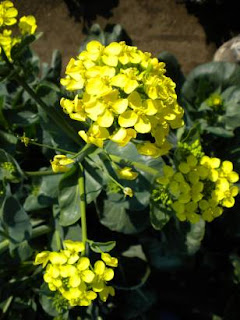
And what magnificent blooms they are, I must say! Their scent is utterly extraordinary - reminiscent of lilacs but more subtle- and their bright yellow is charming. The farmer's shake their heads at me and passersby do a bit more than hint that these greens are too big to eat, but I still keep them. (The leaves and flowers are quite edible, actually, although the lower leaves aren't overly attractive.) Despite the pressure to remove them, what's got me really dragging my garden gloves is the sight of so many bees and insects working amongst them. I've never seen so many in my garden, and I'm delighted. I'm even considering planting more of these vegetables elsewhere and letting them go to seed to keep those pollinators happy. And to enjoy a few more small bites of some of our favorite greens in salads, too.

Wednesday, December 29, 2010

Green Tea Seed Research

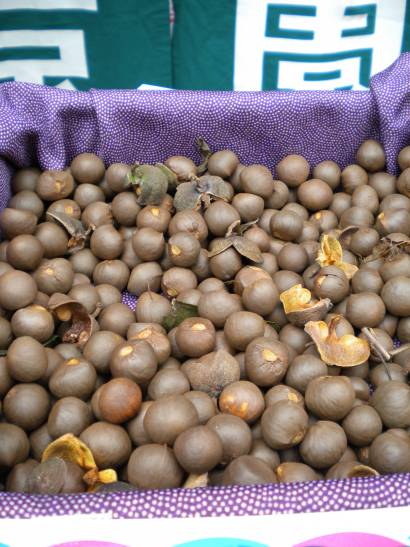
November found me visiting one of the many Tokyo farmer's markets to see what seasonal offerings were available. While visiting the Ebisu Farmers Market in November I met Noriko and Unikyo Sakyoen of Sakyoen Teas. They, of course, were selling their tea, but what drew me to their booth was the little box of brown balls pictured at left. Thinking with my sweet tooth, I assumed these were some kind of Japanese sweet I'd not met yet. Also thinking they were free samples, I jetted directly over.

These are not something to be nibbled with tea, but they are tea itself. Green tea seedpods, to be exact. Rough to the touch and nearly light as a feather, they rattled a bit as I rolled them about in my hand. Sankyoen-san patiently explained to me in the simplest Japanese he could muster what they were and how to plant them. They have since sat in a small bowl on my bookcase waiting for me to make my move.

While Sankyoen-san's advice is certainly sound (as the twelfth generation of his family to grow tea, I assume his knowledge is near encyclopedic), I also did a bit of research on my own to find more details than my limited language skills and his busy market table would allow. The general consensus seems to be that the seeds need to be kept moist and planted fairly quickly in order to remain viable. (Mine have not had the advantage of either of these things, so I'm a little concerned.) Some sources recommend scarification of the seeds, and other simply recommend soaking until the seeds crack. If the seeds float, they are not viable at all and should be composted. (Mine are floating just now, but I'm hopeful they'll sink. If that means they are still viable, I don't know.)

Despite learning yesterday that my hopes of home tea growing are sunk (the seed pods did not sink or crack or anything), I did manage to find the following links that were incredibly useful for growing from seed or cuttings.

Easily the best resource comes from The Field Alliance (formerly known as the Community IPM Programme), an organization working to keep farming a viable economic alternative in rural communities in Southeast Asia. Their Tea Eco-Guide gives detailed information on growing from seeds or cuttings as well as soil preparation. Arguably, it is more than the home patio grower needs, but it makes good reading and satisfied my desire for solid information.

The University of Florida Extension Service offered good information for the home grower as did Narien Tea Store. (I don't usually reference company sites, but their information about growing was some of the best I found.)

Friday, March 27, 2009

Kale Seedlings Revealed

The Russian Kale seeds I put in just over a week ago have sprouted! I went out on the balcony to putter with some of the other pots, and decided to look once again to see if anything was happening in that section. Much to my joy, there they were standing tall (for early sprouts) above the dirt in the pot!

I ran back inside to get the camera, as any dutiful new parent would, and took pictures enthusiastically. The seedlings are a little difficult to see unless you really know what you're looking for, but they are present. Once I got to looking I counted about four or five, and I'm betting that even more have arrived since yesterday. I am simply thrilled!

Sunday, March 22, 2009

Seedlings in the Window

I started some of our first seedlings this past Friday using old sushi containers from a take-out meal earlier in the week. The containers are plastic with lids that fold or swing back making them nearly perfect for starting seeds. 


One container holds some Green Zebra seeds from Project Grow's awesome heirloom seed collection that I bought at the People's Food Coop. (Just so folks know, I blog for Project Grow and I served on the Board at PFC.) I first ate these tasty tomatoes last summer while working at Frog Holler Farm. I'd never seen a green tomato before, much less tasted one. I don't even remember exactly why I dug into one at long last, but I'm sure glad I did! The lemony taste and cute size of these little gems makes them one of the best tomatoes I've ever had. (It is hard to top a Brandywine, too, but I tend to eat those like my Wisconsin people. I cut it into thick slices with a sprinkle of sugar on top, and then eat it like I would a juicy steak.)


The other container holds some sweet basil seeds that our apartment's former residents left behind for us. I've got my fingers crossed that these sprout and do well. I've had mixed luck with seeds in the past, and so I'm hopeful but a wee bit sceptical, too. Luckily, I've seen basil seedlings at the local nursery as well as at another garden store at Kichijoji. There will be pesto! (Once we give in to the super pricey olive oil prices, that is, and walnuts. Yikes!)

I'm hoping to start some other seeds today or tomorrow of bok choi, peas, and cardinal climber. I The last two I imagine on trellis' climbing around our balcony. I've got a couple moshi containers from yesterday (more on that later) that should be good for those. 

Saturday, March 1, 2008

Svalbard Seed Bank - A Hot Spot in a Cool Place

The seed bank in Svalbard is not exactly the next big vacation spot, but for those who think about food production and participate in it, even at the gardening level, it is very exciting!

The seed bank is meant to store seed samples from around the world - Mexico, Africa, and India to name a few - in an effort to save endangered plants from extinction as well as preserve biodiversity. Seed banks preserve seeds of fruits and vegetables from natural disasters, wars, and industrial farming. Recent changes in the political and global climate spurred the construction of an international seed bank to house and protect seeds from around the world. Construction began in 2006, and cooling in November, 2007. The seeds need to be kept at minus 20 degrees Celsius. Seed Savers Exchange deposited samples of their seeds, along with other organizations and seed banks from around the world. Organized in part by the Global Crop Diversity Trust, the seed bank will be a vital resource for the future.

Take a look at the seed bank and its construction, while this article from the San Francisco Chronical offered further information.

Saturday, December 29, 2007

Early New Year

As the snow flies, the rain freezes, and I nibble the treats left in my stocking, the New Year has arrived. Well, in some ways it has. Seed catalogs for 2008 are piling up next to my chair.

Seed Savers came first with great pictures, and inspirational names for everything from beans (Calypso, Dragon's Tongue, Lina Cisco's Bird Egg) to watermelon (Moon & Stars, Osh Kirgizia, and Melitpolski). The Osh Kirgizia is particularly exciting as I suspect it may be similar to those I ate while in Peace Corps Kazakhstan. (So sweet, so perfect. Still one of my fondest memories.)

Johnny's Selected Seeds came next, and I found myself eye-balling the flower selection. Calendula specifically, as I have come to love those blooms (in my salads as well as vases about the house) almost as much as zinnias. Our neighbors at Frog Holler Farm introduced me to edible flowers five years ago, and I've never looked back. (Mostly because I'm too busy eating their fantastic salad mix or produce!)

And finally, the Burpee catalog came. While not organic or full of heirloom varieties, I still enjoy seeing what they have to offer.