While I'm biking around Hokkaido this month, Van Waffle, a Canadian writer, blogger, and food-foraging-fun-guy, agreed to share some of his favorite seasonal fruit hunting. If you like this, check out his earlier post on the natural beauty of Guelph's two rivers. Better yet, cruise on over to his blog, Speed River Journal, for more recipes, reflections, and all around good writing! Enjoy!
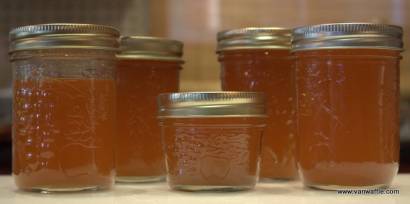 |
| Rose hip jam ready for toast! |
Foragers cannot rely too heavily on a
grocery list. I doubt we will find any delectable oyster mushrooms
during the great North American drought of 2012. Still there is
plenty to find around the city. Be observant and prepare to
experiment—with a good field guide in hand, of course. This week I
discovered peppermint in some marshy ground in the park; also a
population of stinging
nettles to satisfy my hankering for pesto d’urtica next
spring.
 |
| A wee red mulberry. |
Red mulberries
Keep an eye open for mulberries in late
July and early August. They are sweet, flavorful and worthy of a pie.
Various species are scattered in temperate and tropical regions of
the world.
I grew up with two venerable red
mulberry trees beside our house: sprawling beasts with massive
trunks, perfect for tree forts. The fruit attracted orioles, cedar
waxwings and other birds. For several weeks every summer the berries
turned our patio and bare feet blue. I grazed but my mother, lacking
any recipe, never cooked with them. Sadly, both trees attracted
lightning.
Red mulberry is endangered in Canada.
Guelph lies at the northern extreme of its range. I do not mind
climate change making Ontario a better environment for this and other
native Carolinian species.
I know of two mulberry trees in the
city, so we went looking. Parking the car on the right street, I
noticed a long hedge of rugosa roses covered with red hips.
Unfortunately, we found the mulberry’s branches practically bare. I
do not know whether to blame drought, birds or sharper foragers.
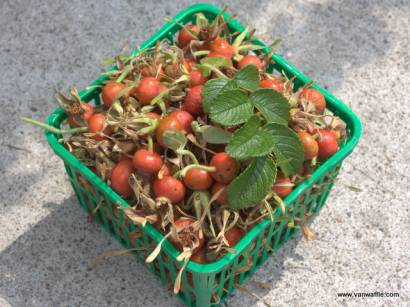 |
| A quart of fresh rose hips ready for jammin'! |
Rose hips
We turned instead to the prolific rose
hedge. Most of our native species produce small hips hardly worth the
trouble. Rugosas are a hardy, salt-tolerant, disease-resistant Asian
species favored for landscaping. The shrubs look coarse and the
petals are boring pink, but the flowers are intensely fragrant and
good for potpourri.
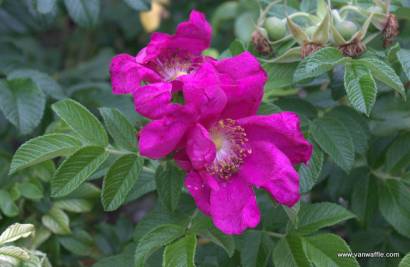 |
| Rugosa rose blooms |
I had also heard their plump hips are
great for cooking. Last frost is supposed to be the best time to
harvest, but these bushes were visibly drought-stressed so there
would be little advantage in waiting. I tested one. The flavor was
bright and zingy as the color, slightly spicy. We easily picked two
quarts.
Rose hips contain more vitamin C than
oranges, and lots of natural pectin. The hairy seeds can irritate
both skin and gut, but are high in vitamin E. When dried, rubbed to
remove the hairs, and ground they can be used as a natural
supplement.
We had never cooked with rose hips
before, so opted for simple jelly. Once they had simmered, my
mother’s old-fashioned cone sieve with masher did a great job on
them, but a potato masher will also work. The fruit has lots of
flavor but sweetener is required.
Rose hip jelly
2 quarts large rose hips
⅓ cup lemon juice
1 package no sugar added pectin
2 cups organic cane sugar (or
substitute any sweetener of your choice)
¼ teaspoon butter
1. Wash and sterilize 6 half-pint
canning jars and lids.
2. Remove rose hip stems and tops and
rinse. Cover with 1½ quarts of water, bring to a boil and simmer for
90 minutes (less for smaller-hipped rose varieties) or until they are
soft.
3. Strain through cheesecloth and
reserve the juice. Mash the hips. Drain the pulp for at least an
hour, collecting any liquid. Strain the juice through cheesecloth and
measure. If necessary, pour more boiling water through the pulp and
strain the runoff to obtain a total of 3½ cups of juice.
4. Add lemon juice and pectin and stir
to dissolve. Bring juice to a boil. Add sugar. As soon as it
dissolves add butter to reduce foam. Bring to a full boil that cannot
be stirred down. Boil exactly one minute.
5. Pour jelly into sterilized jars.
Apply lids and rings.
6. Process in a boiling water bath for
10 minutes. Let cool overnight. Check the seals. If a lid does not
seal, refrigerate the jar and use within three weeks. Otherwise they
can be stored in a cool, dark place for a year.
Makes about 5 pints.
With so much natural pectin, the jelly
started to form as soon as we took it off the heat. The flavor is
delightful, something like apricot marmalade. With a little more
trouble (seeds carefully removed), rose hips would make great jam.
They would also combine nicely with other fruit or herbs, and lemon
balm or verbena would enhance this jelly nicely.
Van Waffle is a Canadian writer. He blogs about urban nature at Speed River Journal: www.vanwaffle.com
Comments