 |
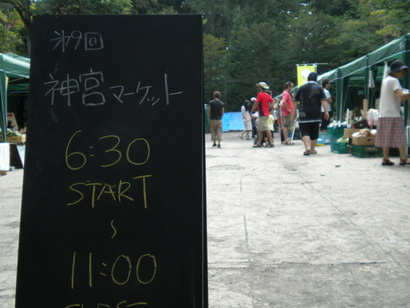
| Sapporo Farmers Market Entrance |
The Sapporo Farmers Market scene,
however, has remained elusive. I've vegetable toured in
Higashikawa and spotted a handful of stands here and there,
but Sapporo gets understandably spurned for more time with good
friends near Asahikawa and subsequent hiking trips or bike
touring adventures.
Yet, Hokkaido is one of Japan's
agricultural powerhouses. Famous for its vast tracks of land (by
Japanese standards), large farms, huge vistas, dairy farms, rice
fields, as well as some of the country's best seafood, I thought
farmers markets would abound. As Hokkaido's largest city and one of
the main portals to the rest of the island, Sapporo should be full of
markets full to overflowing. One website showed me a city dotted with markets – at least
six! - that promised some good vegetable hunting plus a whole lot
more. This would be my year.
Well, not exactly.
It turns out that the markets did exist
for a good two years; however, interest on running them waned, and
now there only one market is left: the Sapporo Farmers Market at the
Hokkaido Shrine.
“One hundred years ago the Maruyama
district of Sapporo had a morning market every day,” said Kanayama,
the market manager. “It was called Maruyama Asaichi. But now,
there's only this one.”
Set just outside the main entrance to
the Hokkaido Shrine, the Sapporo Farmers Market is small but
comprehensive and easy to find. Organic and conventional growers
offer up the season's harvest each month while local producers of
jam, honey, and assorted Japanese pickles set out a tasty spread of
their own. Nearly thirty vendors come, some from as far away as
Niseko and Tokachi (roughly 1800 km), each month from June to
September to sell their wares to an estimated 1,000 visitors who are
a mix of locals and tourists.
 |
| Niseko Green Farm's beautiful beets. |
“I wish I had some carrots to offer
you, but they just sold out,” said Denis of Niseko Green Farm,
an all organic operation he's been running for upwards of four years
now. His journey from Holland to a Tokyo restaurant to running a farm
in Fukushima Prefecture to Hokkaido where he farms and skis sounds
confusing at best. But seeing him behind the table talking with
customers about his produce makes the logic apparent. Explaining a
new variety of pepper or tomato to a skeptical looking customer is
all part of a days work at the market, as any vendor can say. It's
the opportunity to connect with people directly that makes all the
difference.
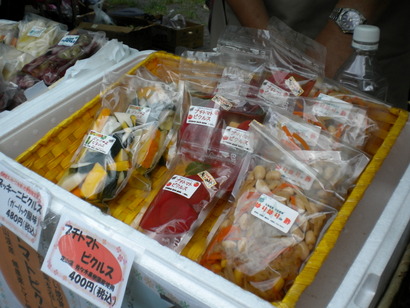 |
| Hitoshi Fujita's amazing pickles. |
“Most people learn to make
traditional pickles from their mother who learned it from her mother
who learned it from her mother. But that doesn't happen any more, so
my daughter and I decided to do it now. Our recipes are a mix of
traditional and new things so young people eat it then,” he said
with a smile.
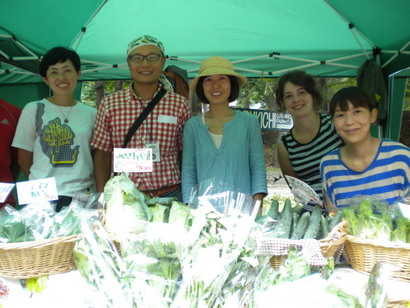 |
| Takuya Kobayashi and his happy crew. |
Kobayashi, another organic grower like
Denis of Niseko Green Farm, started farming about nine years ago.
When I asked him why he became a farmer, his face turns serious.
“It's difficult to explain,” he says. I can't catch all of the
vocabulary, so he simplifies the story some. At university he
learned what was happening ecologically in the world, and decided he
needed to do something.
“My home was a farm so I decided to
do it,” he said. When I ask if they ever need help, he smiles
broadly and says, “Help is good. Just email.”
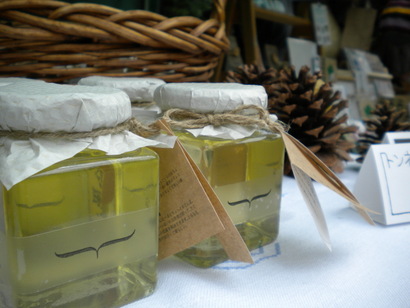 |
| Toneru Yama Honey - Hello, sweet stuff. |
Toneru Yama Honey has a pretty little
table of jars full of golden light, and a book of herbs open in
front. A small bouquet of herbs and wild flowers sits just behind the
jars of honey. Less than a year old, they only have two hives in
Nishiku at the moment, but from the looks of how sales went they may
need to expand.
“The honeybees need us,” said one
of the staff when I ask why they started. She and two friends studied
books and found a local teacher to help them. “If we want
vegetables, we need bees. If I want to have a life, a living, then I
need bees.”
I continued my rounds of the green
tents to get a good look and, to be honest, drool a little. Early
August is prime corn season here, and there's heaps of it to be had.
But that means peeling and shucking, and a train isn't the best place
for that. Hokkaido's cooler climate is similar to my American
Midwest, so I see many of my all-time favorites looking luscious and
lovely and reasonably priced. My husband firmly denies that eating
beets raw on the train is a good idea. I finger the purple and green
leaves sadly before opting for a carton of red, green, and orange
tomatoes instead. Lovely ceramics, candles, and hand-woven scarves
can only be consumed with my eyes. We're bike-touring for another
eleven days. Space is at a premium already in our packs on the
trailer.
Sapporo Farmers Market
Hokkaido Shrine, Maruyama Park, Sapporo
June through September
Second Sunday of the month
6:30am - 11am
Map
Sapporo Farmers Market
Hokkaido Shrine, Maruyama Park, Sapporo
June through September
Second Sunday of the month
6:30am - 11am
Map
Comments